



What's Happening?
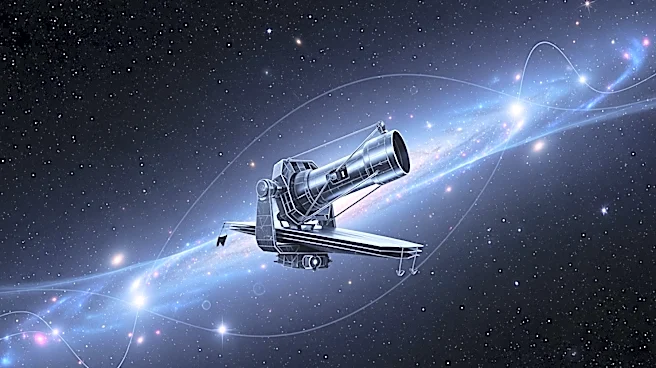
The Dark Energy Spectroscopic Instrument (DESI) has successfully completed the largest high-resolution 3D map of the universe, marking a significant milestone in the study of cosmic expansion. DESI's 5,000 fiber-optic sensors captured their final observations,
focusing on a region near the Little Dipper. This project, involving global institutions such as the University of Portsmouth and Berkeley Lab, has exceeded its data collection goals, providing more information than initially projected. The data is being used to investigate dark energy, a mysterious force constituting about 70% of the universe, which drives its accelerating expansion. Early results suggest that dark energy might be evolving over time, challenging the long-held belief of it being a cosmological constant.
Why It's Important?
The completion of DESI's 3D map is crucial for cosmology, offering unprecedented insights into the universe's structure and evolution. The potential discovery of evolving dark energy could revolutionize our understanding of the universe's fate, impacting theories about cosmic expansion and the balance between matter and dark energy. This research could also lead to new discoveries about fundamental particles like neutrinos. The project exemplifies international collaboration in scientific research, involving over 900 researchers from more than 70 institutions worldwide, and is managed by the US Department of Energy's Lawrence Berkeley National Laboratory.
What's Next?
With the full dataset now available, researchers will begin processing the information, with initial results expected by 2027. The survey will continue to expand, covering new regions of the sky and revisiting previously mapped areas to observe new classes of galaxies. This ongoing work aims to refine dark energy measurements and produce additional findings on the universe's structure. The extended survey will enhance the map's detail, providing a sharper view of cosmic evolution.