


What's Happening?
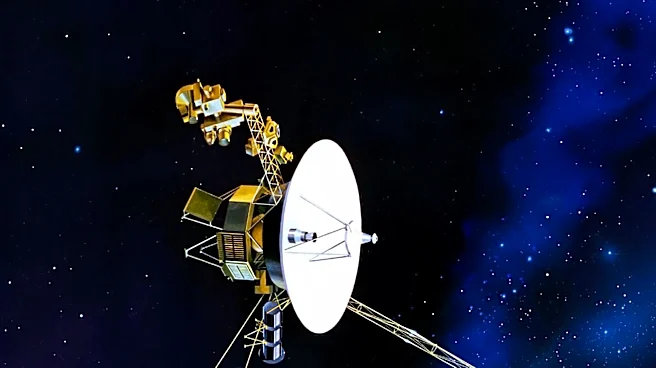
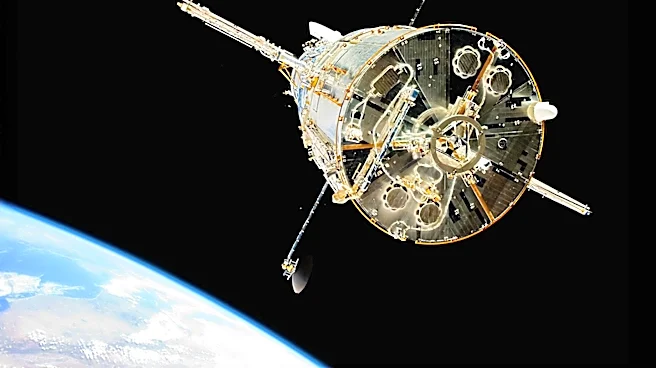
NASA's Voyager 1 spacecraft is set to achieve a significant milestone on November 18, 2026, when it will cross the one-light-day mark, positioning it approximately 16.1 billion miles from the Sun. Launched in 1977 alongside its twin, Voyager 2, the mission
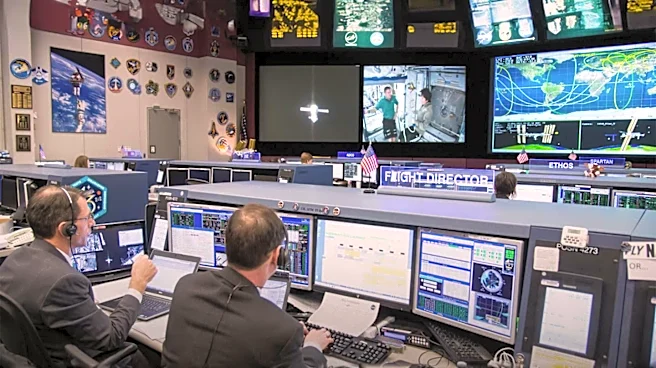
capitalized on a rare planetary alignment of Jupiter, Saturn, Uranus, and Neptune, occurring once every 175 years. This 'Grand Tour' utilized gravity assists from these gas and ice giants to propel the spacecraft, providing unprecedented close-up views of the outer solar system and several of their moons. Both Voyager probes have since ventured beyond the heliopause, the boundary where the Sun’s solar wind meets the interstellar medium, with Voyager 1 crossing in August 2012 and Voyager 2 in November 2018. The spacecraft continue to transmit valuable scientific data back to Earth via NASA’s Deep Space Network.
Why It's Important?
The Voyager mission represents one of humanity's most ambitious and successful endeavors in space exploration, fundamentally reshaping our understanding of the outer solar system and interstellar space. Voyager 1 reaching the one-light-day distance underscores the incredible longevity and resilience of these probes, which have operated far beyond their initial design lifespan. The data they continue to send back provides unique insights into the interstellar medium, helping scientists understand the environment beyond our solar system. This mission has paved the way for subsequent ambitious orbiter missions like Galileo to Jupiter and Cassini to Saturn, demonstrating the effectiveness of gravity-assist maneuvers for deep-space travel. The ongoing success of Voyager also highlights the enduring legacy of NASA's scientific and engineering capabilities, inspiring future generations of space explorers and researchers.
What's Next?
As Voyager 1 continues its journey further into interstellar space, NASA will maintain communication through the Deep Space Network, collecting data for as long as the spacecraft's power systems remain operational. Scientists will continue to analyze the information received, seeking to understand the properties of interstellar space, cosmic rays, and the heliosphere's interaction with the broader galaxy. The mission's longevity also presents ongoing challenges in managing aging hardware and power constraints, requiring innovative solutions from NASA engineers. Future deep-space missions will undoubtedly draw lessons from the Voyager program's design, operational strategies, and scientific discoveries, influencing the development of new technologies for exploring the farthest reaches of our solar system and beyond.
Beyond the Headlines
Beyond its scientific achievements, the Voyager mission carries profound cultural and philosophical significance. Each spacecraft carries a 'Golden Record,' a time capsule containing sounds and images selected to portray the diversity of life and culture on Earth, intended for any intelligent extraterrestrial life that might encounter them. This artifact represents humanity's message to the cosmos, a testament to our curiosity and desire for connection. The concept of a 'light-day' as a measure of distance, rather than time, also prompts a deeper reflection on the vastness of space and our place within it. The Voyager mission serves as a powerful symbol of human ingenuity, perseverance, and our innate drive to explore the unknown, pushing the boundaries of what is possible and expanding our cosmic perspective.