


What's Happening?
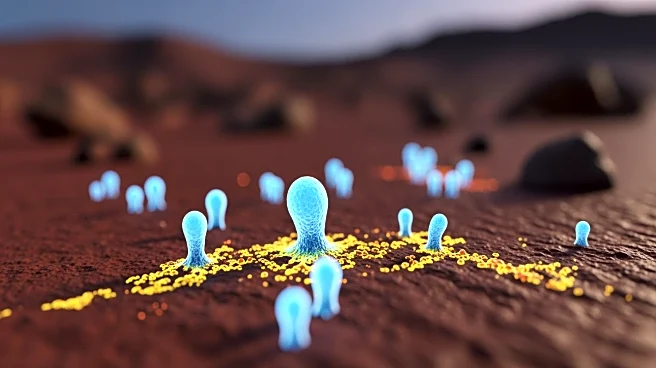
Research into Earth's toughest microbes suggests they could play a crucial role in enabling human life on Mars. Scientists are exploring the potential of biomineralization, a process where microorganisms create minerals, to transform Martian regolith
into building materials. This approach could facilitate the construction of habitats on Mars using local resources, reducing the need for costly material transport from Earth. The study focuses on a partnership between two bacteria, Sporosarcina pasteurii and Chroococcidiopsis, which together can produce cement-like substances and support life systems. This innovative method could revolutionize how structures are designed and built on Mars, contributing to sustainable human settlement.
Why It's Important?
The ability to construct habitats on Mars using in situ resources is critical for the feasibility of long-term human presence on the planet. This research offers a promising solution to one of the major challenges of Mars colonization: building durable structures in a harsh environment. By leveraging microbial processes, scientists can create materials that are both strong and sustainable, potentially reducing the cost and complexity of Mars missions. Additionally, the production of oxygen by Chroococcidiopsis could support life support systems, further enhancing the viability of human habitation.
What's Next?
The research is still in its early stages, with further studies needed to test the effectiveness of microbial mineralization under Martian conditions. Scientists will continue to refine their methods using Martian soil simulants and develop protocols for autonomous construction. As space agencies plan crewed missions to Mars in the coming decades, advancements in bio-derived construction techniques will be crucial. The ongoing research will also explore the potential for these microbial processes to contribute to Mars's terraforming efforts, paving the way for a future where humans can thrive on the Red Planet.