




What's Happening?
Astronomers at the Massachusetts Institute of Technology (MIT) have reported the discovery of a unique celestial system, ZTF J0440+2325, where a small red dwarf star is actively accreting material from a brown dwarf. This red dwarf, located approximately
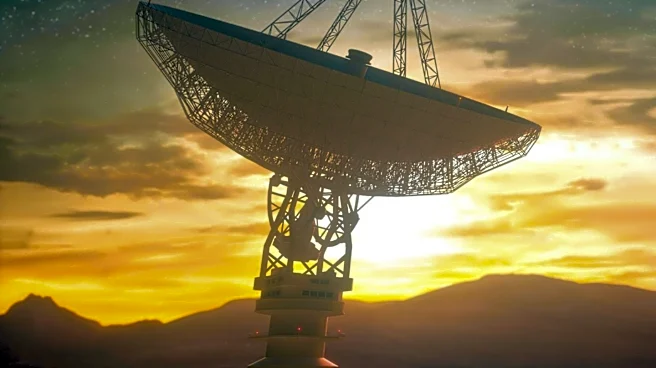
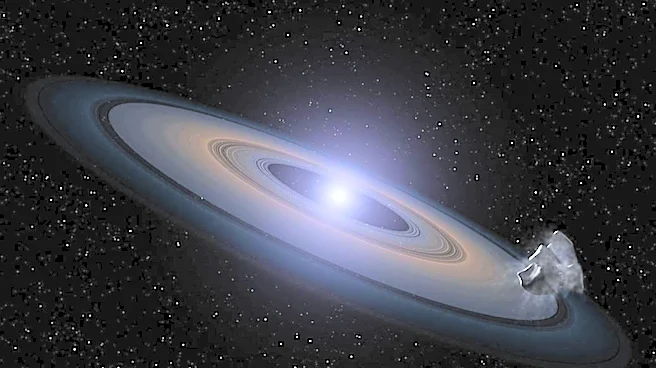
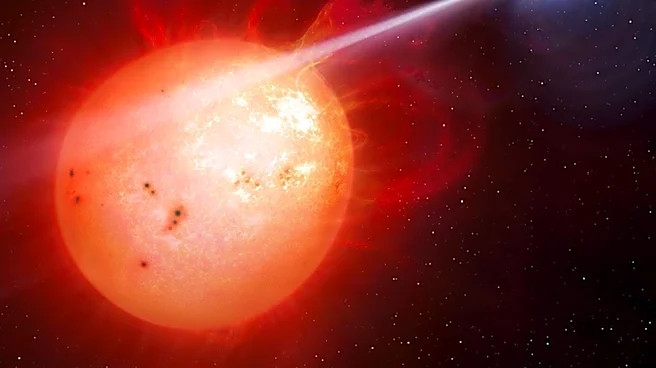
300 light-years from Earth, is slowly stripping gas from its companion brown dwarf, which orbits it every 87 minutes. The brown dwarf, roughly 25 times the mass of Jupiter, is heavier than a planet but lacks the mass to sustain hydrogen fusion like a true star. The red dwarf, with about 85 times the mass of Jupiter, pulls gas from the brown dwarf, and this material directly impacts the star's surface, creating a hot spot. This process is estimated to transfer about one hundred-thousandth of Earth's mass per year. The team also identified a second candidate system, ZTF J1444+4820, with an even shorter orbital period of about 67 minutes, though the evidence for this second system is weaker. The discovery was made using data from the Zwicky Transient Facility at Palomar Observatory, which detected an unusual triangular light curve, and was confirmed with follow-up observations from other telescopes.
Why It's Important?
This discovery is significant because it represents the first observed instance of a low-mass star steadily accreting material from another low-mass object. Previously, astronomers had observed stable planetary systems and stars rapidly engulfing planets, but a slow, continuous transfer of material over millions or even billions of years between such low-mass objects had not been documented. This finding fills a crucial gap in understanding the dynamics of close-orbiting celestial bodies and how they interact. It challenges existing models of accretion, which typically associate such processes with dense, compact objects like white dwarfs, neutron stars, and black holes where material often forms a disk before falling inward. In this new system, the material lands directly on the small star, a process whose heating effects are largely unexplored in current models. The existence of such a system suggests that the long-term, gradual consumption of a companion object might be a more common phenomenon than previously thought, potentially reshaping how scientists view the evolution and interaction of stars and their companions.
What's Next?
The discovery of ZTF J0440+2325 opens new avenues for astronomical research. The team plans to search for more similar systems using data from large sky surveys like the Zwicky Transient Facility and the upcoming Vera C. Rubin Observatory. Identifying additional examples will help determine how common this slow consumption process is and whether it represents a rare curiosity or a frequent outcome for close-orbiting companions. Further observations and modeling will be crucial to understand the long-term implications of this accretion process, including the lifespan of such systems and the ultimate fate of the brown dwarf. Researchers will also focus on refining the measurements of the objects' masses and the rate of material transfer, as current estimates carry some uncertainty. The study of these systems could lead to a deeper understanding of the diverse ways planets and brown dwarfs interact with their host stars, potentially leading to revisions in theories of stellar and planetary evolution.
Beyond the Headlines
The direct accretion of material from a brown dwarf onto a red dwarf star, as observed in ZTF J0440+2325, highlights the complex and often unexpected dynamics within stellar systems. This phenomenon challenges the traditional understanding of how celestial bodies interact, particularly in close orbits. The fact that the material is directly impacting the star rather than forming an accretion disk suggests unique physical processes at play, which could have implications for our understanding of stellar atmospheres and energy transfer. The long-term nature of this 'slow meal,' potentially lasting for millions to billions of years, also raises questions about the longevity and stability of such systems. It prompts a re-evaluation of the conditions under which objects can coexist in extremely close proximity without immediate catastrophic engulfment. This discovery underscores the vastness of unknown phenomena in the universe and the continuous need for observational astronomy to refine and expand our theoretical models of cosmic evolution.