



What's Happening?
Astronomers using the MeerKAT radio telescope in South Africa have identified the most distant hydroxyl megamaser ever detected, located in a galaxy over 8 billion light-years away. This discovery marks a significant advancement in radio astronomy, as hydroxyl megamasers
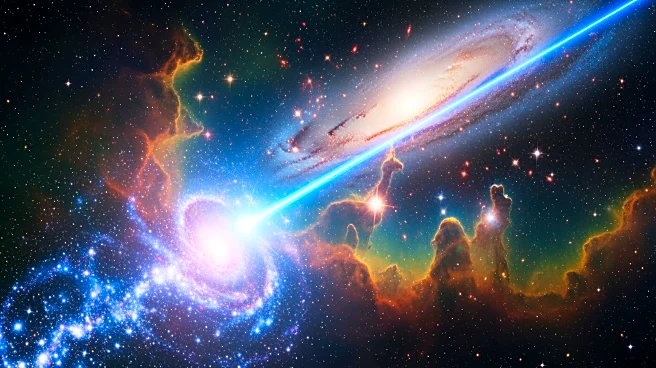
are natural 'space lasers' that emit extremely bright radio-wavelength emissions. These emissions occur when hydroxyl molecules in gas-rich, merging galaxies collide, compressing gas and amplifying radio emissions. The newly discovered system, HATLAS J142935.3-002836, is so luminous that it is classified as a gigamaser. The signal was further amplified by a phenomenon known as strong gravitational lensing, where a foreground galaxy acts as a lens, enhancing the radio waves' journey to Earth.
Why It's Important?
The discovery of this cosmic gigamaser opens new frontiers in radio astronomy, providing insights into the universe's evolution. Hydroxyl megamasers are rare and trace vigorous galaxy collisions, which are crucial for understanding cosmic evolution. The ability to detect such distant and luminous signals demonstrates the capabilities of the MeerKAT telescope and highlights South Africa's growing leadership in data-intensive radio astronomy. This finding also underscores the potential of systematic searches to convert rare phenomena into powerful probes of cosmic history, offering a deeper understanding of galaxy formation and evolution.
What's Next?
The discovery is just the beginning of a broader effort to identify more such systems. Researchers at the University of Pretoria are conducting systematic surveys to find hundreds to thousands of similar systems. These efforts are supported by advanced computational infrastructure and data processing pipelines, which are essential for analyzing the vast amounts of data collected by MeerKAT. The ongoing research aims to prepare for the Square Kilometer Array, a future radio telescope project that will further enhance the study of cosmic phenomena.