






What's Happening?
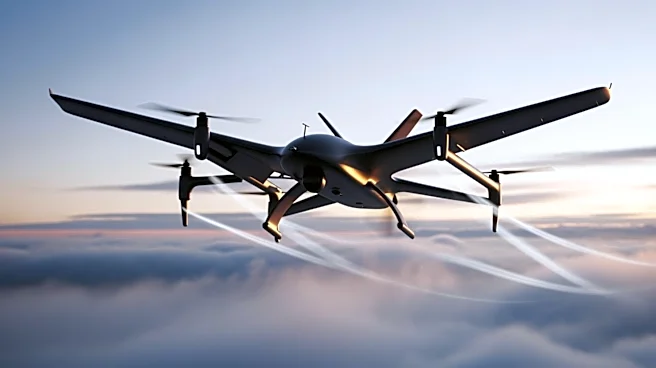
JOUAV has introduced the CW-80E, a Vertical Take-Off and Landing (VTOL) Unmanned Aerial System (UAS) designed for weather modification missions such as cloud seeding and precipitation enhancement. This system is built on a large fixed-wing platform, allowing
for improved operational efficiency and safety by reducing reliance on manned flights. The CW-80E is equipped with integrated flight control and payload management systems, enabling precise execution under variable atmospheric conditions. It can carry warm cloud flares and a cloud particle imaging payload, allowing operators to analyze cloud microphysical conditions and execute targeted seeding. The drone has a maximum takeoff weight of 100 kg, a 5-meter wingspan, and can operate for up to 8 hours, covering an operational radius of 100 to 200 km.
Why It's Important?
The introduction of the CW-80E reflects a broader industry trend towards utilizing medium- and large-sized Unmanned Aerial Vehicles (UAVs) for environmental management and atmospheric intervention. This development provides agencies with flexible, scalable tools for weather-related operations, particularly in regions with limited infrastructure or challenging terrain. The use of UAVs in weather modification can enhance the precision and cost-effectiveness of such operations, potentially leading to more efficient management of water resources and disaster mitigation efforts. This shift also represents a move towards reducing the environmental impact of traditional manned aircraft operations.
What's Next?
The deployment of the CW-80E is likely to encourage further innovation and investment in UAV technology for environmental applications. As the demand for precise weather modification grows, more companies may enter the market, leading to increased competition and technological advancements. Regulatory bodies may also need to adapt to the growing use of UAVs in atmospheric operations, potentially leading to new guidelines and standards for their use. Additionally, the success of the CW-80E could prompt other industries to explore UAV applications in areas such as agriculture, forestry, and disaster response.