







What's Happening?
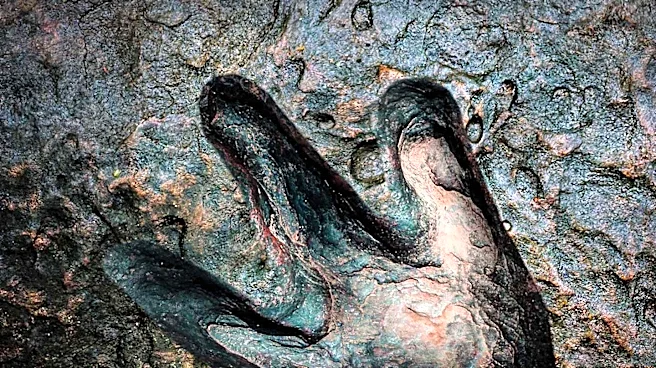
A pair of hikers in the Italian Alps have stumbled upon a significant paleontological find: reptile footprints dating back 280 million years. The discovery was made by Claudia Steffensen and her husband while hiking in Val d’Ambria. The footprints, believed
to be from a reptile ancestor of dinosaurs, were confirmed by paleontologists at the Natural History Museum of Milan. This find has led to further excavations, revealing more fossilized tracks from various species, offering a unique opportunity to study the biodiversity and paleoenvironment of the Permian period.
Why It's Important?
This discovery is crucial for paleontologists as it provides a rare glimpse into the biodiversity of the Permian period, a time before dinosaurs roamed the Earth. The footprints offer insights into the types of creatures that existed and their interactions with the environment. Such findings can enhance our understanding of evolutionary history and the geological changes that have occurred over millions of years. For the scientific community, this represents a chance to reconstruct ancient ecosystems and understand the conditions that led to the rise of dinosaurs.