
What's Happening?
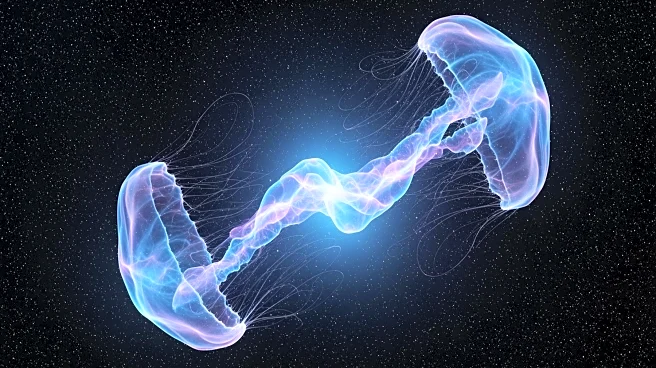
The James Webb Space Telescope has identified a 'cosmic jellyfish' galaxy, COSMOS2020-635829, located 8.5 billion light-years away. This galaxy features trailing tendrils of gas, indicative of powerful environmental forces within galaxy clusters. The discovery,
made in the COSMOS field, provides new insights into galactic evolution during the universe's early stages. The tendrils, formed through ram-stripping, contain young stars born outside the galaxy's main disk. This finding challenges previous assumptions about the conditions necessary for such phenomena, suggesting that galaxy clusters were capable of altering galaxy properties earlier than previously thought.
Why It's Important?
This discovery enhances our understanding of galaxy formation and evolution, particularly during the universe's formative years. The presence of jellyfish galaxies at such an early stage suggests that environmental forces in galaxy clusters were more influential than previously believed. This could reshape theories about the development of 'dead' galaxies and the role of cluster environments in galactic transformation. The findings also highlight the capabilities of the James Webb Space Telescope in uncovering new cosmic phenomena, potentially leading to further breakthroughs in astrophysics.