






What's Happening?
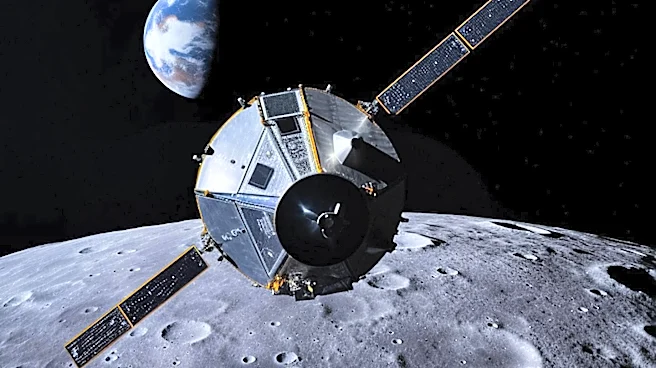
NASA's Artemis I mission has provided new data on cosmic radiation levels near the Moon, utilizing experimental detectors made from lithium fluoride crystals aboard the Orion spacecraft. These detectors, developed by scientists at the Institute of Nuclear
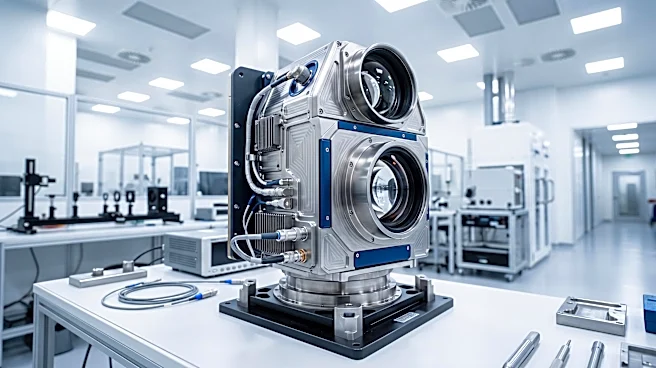
Physics of the Polish Academy of Sciences (IFJ PAN), were embedded in two human-shaped mannequins during the uncrewed mission in late 2022. The research, published in the journal Radiation Measurements, describes a new method for analyzing the information stored in these crystals. The detectors work by capturing microscopic changes caused by radiation, where charged particles disrupt the crystal's atomic structure, creating 'color centers.' When illuminated with blue light, these altered regions glow red, allowing researchers to identify radiation particle paths. This technology offers a simplified process for examining radiation tracks compared to traditional plastic detectors, which require chemical etching. The MARE (Matroshka AstroRad Radiation Experiment) study, which included these detectors, aimed to understand radiation exposure in the lunar environment.
Why It's Important?
The findings from the Artemis I mission are crucial for understanding the radiation environment beyond Earth, which is vital for the safety of future human space exploration. Unlike low Earth orbit, where the Van Allen radiation belts contribute significantly to radiation exposure, the lunar environment presents a different challenge with a greater contribution from high-energy galactic particles. The study revealed that while total radiation doses near the Moon are higher than in Earth orbit, the difference is not as dramatic as previously assumed. This nuanced understanding of radiation distribution—almost uniformly throughout the mannequins near the Moon versus uneven patterns in Earth orbit—will inform the design of protective measures and mission planning for astronauts. The compact size and improved resolution of the new lithium fluoride detectors also represent a significant advancement in radiation monitoring technology, potentially offering a more complete picture of the complex radiation environment and enhancing astronaut safety.
What's Next?
The continued refinement and deployment of these advanced lithium fluoride detectors will be critical for future space missions. Their ability to provide sharper images of particle tracks and detect a broad variety of particle types and energies will allow scientists to more accurately assess radiation exposure. This improved data will directly influence the development of more effective radiation shielding and operational protocols for astronauts traveling to the Moon and beyond. The research also highlights the ongoing need for sophisticated calibration and analysis techniques to interpret complex cosmic radiation data. Future missions will likely incorporate these or similar advanced detectors to gather more comprehensive data, further refining our understanding of deep space radiation and ensuring the long-term health and safety of human explorers.
Beyond the Headlines
The development of these advanced radiation detectors has implications beyond space exploration, potentially benefiting fields that deal with radiation exposure on Earth, such as medical imaging or nuclear safety. The ability to detect neutrons, particularly with lithium-6 enriched crystals, expands the utility of this technology. Ethically, a more precise understanding of radiation risks allows for better-informed decisions regarding the acceptable limits of human exposure in space, balancing the drive for exploration with astronaut well-being. Culturally, these advancements underscore humanity's persistent drive to push the boundaries of scientific understanding and technological innovation in challenging environments. The long-term shift could be towards more personalized and real-time radiation monitoring for individuals in various high-radiation professions, leveraging the compact and high-resolution capabilities demonstrated by these space-borne detectors.