



What's Happening?
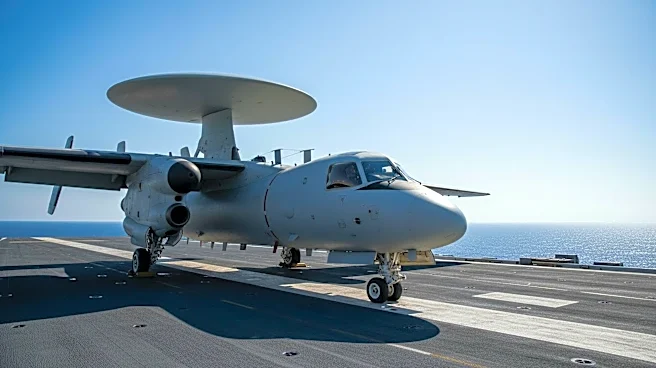
The U.S. Navy has approved Block II upgrades for its E-2D Advanced Hawkeye fleet, following Northrop Grumman's successful completion of a critical design review (CDR). This modernization effort, the largest since the E-2D's development in 2007, aims to
enhance the aircraft's operational capabilities and introduce an open-systems architecture. The upgrades include a state-of-the-art cockpit, increased computing power, and robust cybersecurity, all designed to improve situational awareness and reduce crew workload. The E-2D serves as the Navy's primary tactical airborne early warning and command-and-control aircraft, equipped with the AN/APY-9 active electronically scanned array (AESA) radar to detect aerial threats. Northrop Grumman plans to integrate these upgrades into both new production aircraft and existing E-2D planes, with integration and testing beginning immediately and the first Block II aircraft expected for delivery by the end of the decade.
Why It's Important?
This upgrade is crucial for maintaining the U.S. Navy's technological superiority in airborne command and control. The E-2D Advanced Hawkeye is vital for detecting incoming aerial threats, including cruise missiles and enemy aircraft, and coordinating naval forces in battle. The Block II modernization ensures the aircraft remains a premier asset for maritime dominance by addressing parts obsolescence and enabling rapid, non-proprietary technology insertion. This open-systems architecture approach is significant as it allows for continuous updates to meet evolving threats, reducing long-term sustainment costs and increasing the fleet's adaptability. By reducing pilot workload and enhancing situational awareness, the upgrades will enable crews to manage more complex battlespace scenarios effectively, directly impacting the Navy's operational efficiency and strategic capabilities in contested environments.
What's Next?
Northrop Grumman will immediately begin integrating and testing the Block II upgrades, with flight testing anticipated to commence in fiscal year 2029. The first upgraded E-2D aircraft is scheduled for delivery by the end of the decade. The company will apply the Block II configuration to both newly manufactured aircraft and the existing fleet, ensuring a comprehensive modernization across the board. This phased rollout will allow the Navy to gradually enhance its entire E-2D fleet, ensuring that all aircraft benefit from the improved capabilities. The modular design and use of commercial off-the-shelf products are expected to streamline future upgrades and reduce costs, paving the way for continuous technological advancements without requiring complete system overhauls. This forward-looking approach will ensure the E-2D remains a critical asset for the U.S. Navy and its international partners for years to come.
Beyond the Headlines
The E-2D Block II upgrade signifies a broader strategic shift within the U.S. military towards open-systems architectures and modular designs. This approach is not merely about technological enhancement but also about fostering greater interoperability, reducing vendor lock-in, and accelerating the integration of new technologies. By adopting non-proprietary solutions, the Navy can mitigate the risks of parts obsolescence and ensure that its platforms remain cutting-edge in a rapidly evolving threat landscape. This modernization effort also highlights the importance of continuous investment in existing platforms to extend their operational lifespan and maximize their utility, rather than solely relying on the development of entirely new systems. The long-term implications include more agile defense procurement processes, greater cost efficiency, and a more resilient and adaptable military force capable of responding to diverse global challenges.