







What's Happening?
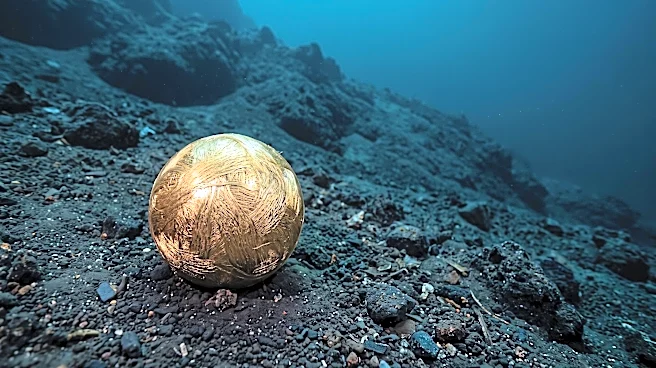
Scientists from the U.S. Government's National Oceanic and Atmospheric Administration (NOAA) have identified a mysterious golden orb discovered in the Gulf of Alaska in 2023. Initially baffling researchers, the object was found during a deep-water mapping
expedition by the ship Okeanos Explorer. The remotely operated vehicle (ROV) Deep Discoverer located the reflective golden blob, approximately 10cm across with a skin-like fibrous texture, at 3,200 meters below the surface on the Walker Seamount. After three years of painstaking analysis, including electron microscopy and whole genome sequencing at the Smithsonian Institution's National Museum of Natural History, the orb was confirmed to be the anchoring cuticle of a giant deep-sea anemone, Relicanthus daphneae. This discovery suggests the species is more widespread than previously thought, as it had only been observed near hydrothermal vents in other oceans.
Why It's Important?
This discovery is significant for marine biology and deep-sea exploration, expanding our understanding of the distribution and life cycles of deep-sea organisms. The identification of the golden orb as a Relicanthus daphneae cuticle highlights the vast unknowns that still exist in the ocean's depths and the potential for new biological insights. The finding also underscores the importance of advanced robotic exploration and genetic analysis in identifying previously uncharacterized marine life. For U.S. scientific institutions like NOAA and the Smithsonian, this success reinforces their role in leading cutting-edge research and conservation efforts in marine ecosystems. The presence of diverse microbial communities on the cuticle also suggests a previously unknown role for these structures in the ocean's nitrogen cycle, potentially impacting broader ecological models.
What's Next?
Future research will likely focus on understanding the full extent of Relicanthus daphneae's distribution and its reproductive strategies, particularly how new anemones might grow from abandoned cuticles. Scientists also aim to determine why the cuticle is golden in color and the exact function of the hole observed in the orb. Further deep-sea expeditions by NOAA and other research organizations are anticipated to explore similar unusual findings and continue mapping the seafloor, potentially uncovering more unknown species and ecological interactions. The ongoing analysis of the microbial communities found on the cuticle could also lead to new discoveries about their role in deep-sea nutrient cycling.
Beyond the Headlines
The discovery of the golden orb and its subsequent identification as an anemone cuticle touches upon broader themes of scientific perseverance and the challenges of exploring extreme environments. It highlights how even in the 21st century, with advanced technology, the deep ocean remains largely unexplored and holds countless mysteries. The 'integrative taxonomic approach' used, combining physical examination with genetic analysis, exemplifies modern scientific methodology in tackling complex biological puzzles. This event also subtly reinforces the value of public funding for scientific research and exploration, as the NOAA, a U.S. government agency, was central to this discovery. The unexpected finding serves as a reminder of the ocean's vast biodiversity and the continuous need for its study and conservation.