







What's Happening?
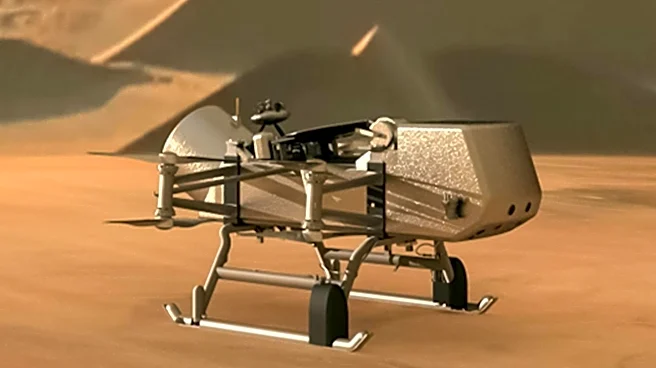
A nuclear-powered 'octocopter' mission named Dragonfly is scheduled for launch in 2028, with an anticipated arrival at Saturn's moon Titan six years later. This ambitious mission aims to explore Titan's surface, which, despite its extreme cold and dark
orange sky, shares similarities with Earth, featuring river channels, lakes, seas, and dune fields. Dragonfly will fly across Titan's landscape, covering several miles per trip, to monitor weather patterns and analyze the soil composition. The primary objective of the mission is to search for elements of life and evidence of life itself. Titan is approximately one and a half times the size of Earth's Moon and possesses a cold, dense atmosphere topped by 'smog.' Its atmosphere, surface, and lakes are believed to contain abundant organic compounds, which are considered the building blocks of life. Scientists hope Dragonfly will help determine if Titan is habitable, potentially resembling Earth during the early stages of life's emergence approximately three and a half billion years ago.
Why It's Important?
The Dragonfly mission represents a significant leap in astrobiological research and planetary science, with profound implications for understanding the potential for life beyond Earth. If successful, the mission could revolutionize our understanding of habitability in extreme environments and broaden the scope of where life might exist in the universe. For the U.S. scientific community, this mission reinforces leadership in space exploration and scientific discovery, attracting top talent and fostering innovation in robotics, nuclear power, and atmospheric science. The data collected by Dragonfly could provide critical insights into the chemical processes that led to life on Earth, offering a unique comparative study. Furthermore, the development of a nuclear-powered octocopter for extraterrestrial exploration pushes the boundaries of engineering and autonomous systems, potentially leading to technological spin-offs that benefit terrestrial applications in areas like remote sensing and energy.
What's Next?
The next critical phase for the Dragonfly mission involves its launch in 2028, followed by a six-year journey to Titan. During this transit period, mission scientists and engineers will continue to refine operational plans and prepare for the complex aerial exploration of Titan's surface. Upon arrival, the octocopter will begin its multi-year mission of flying, monitoring weather, and analyzing soil samples. The scientific community will eagerly await initial data transmissions, which could provide unprecedented insights into Titan's geology, atmospheric conditions, and organic chemistry. Future steps will involve detailed analysis of the collected data to identify biosignatures or conditions conducive to life, potentially leading to follow-up missions or further investigations into Titan's unique environment. The success of Dragonfly could also influence the design and objectives of future missions to other ocean worlds in our solar system.
Beyond the Headlines
The Dragonfly mission's quest for life on Titan delves into fundamental questions about the origins and prevalence of life in the cosmos, challenging our anthropocentric views and potentially redefining what constitutes a habitable environment. The mission's reliance on nuclear power for an 'octocopter' in an extraterrestrial atmosphere highlights the ethical considerations and technological advancements required for long-duration, autonomous space exploration. This mission could inspire a new generation of scientists and engineers, fostering a deeper public engagement with space science and the search for extraterrestrial life. The discovery of even rudimentary organic processes on Titan could have profound philosophical and theological implications, prompting humanity to reconsider its place in the universe and the uniqueness of life on Earth. It also underscores the importance of international collaboration in sharing scientific knowledge and technological capabilities for such ambitious endeavors.