
What's Happening?
TechPolicy.Press reports on the urgent need for new international rules governing AI-enabled weapons, following incidents where autonomous systems have reportedly killed individuals in eastern Ukraine
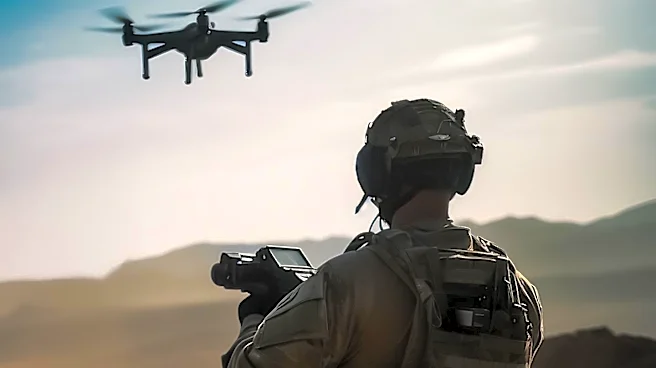
and Zaporizhzhia. The article highlights that many AI-enabled weapons operate as 'black boxes,' exhibiting 'emergent' behavior that cannot be fully predicted or explained, making accountability under existing international humanitarian law difficult. The International Committee of the Red Cross (ICRC) has called for an outright prohibition of these unpredictable systems. The issue is further complicated by the networked nature of 'kill decisions' and the decentralization of new technologies like drone swarms, which challenge the traditional legal assumption of a single, discrete decision for each attack. The report emphasizes that current laws, designed for human decision-making, are inadequate for the realities of digital warfare, where human agency can be severed from the drone's decision matrix, especially in electronically jammed missions.
Why It's Important?
The proliferation of AI-enabled weapons without clear regulatory frameworks poses significant ethical and legal challenges for the U.S. and the international community. The inability to predict or explain the actions of these 'black box' systems makes it difficult to assign accountability for unintended harm, potentially leading to a breakdown of international humanitarian law. This situation could escalate conflicts, as the threshold for deploying lethal force might be lowered if human responsibility is diluted. For U.S. defense policy, this means navigating a complex landscape where technological advancement outpaces legal and ethical guidelines. The lack of clear rules could also impact the development and export of such technologies by U.S. companies, raising concerns about their use by other nations and non-state actors. The debate over autonomous weapons systems will shape future warfare and international relations, with profound implications for global stability and human rights.
What's Next?
Leaders are scheduled to gather at the United Nations in Geneva next week to discuss negotiating a treaty on autonomous weapons. The goal is to act decisively to prevent further deaths from these technologies. A report drafted by governmental experts is on the table, offering a starting point for discussions, but it is noted to fall short in addressing the enforcement gap for weapons operating in unobserved environments. Policymakers will need to consider enforceable obligations for states deploying unpredictable killing machines and establish liability for the tech companies that develop them. Failure to negotiate a new binding treaty could lead to a future where more lives are determined by lines of code, necessitating a re-evaluation of international law to address the evolving nature of warfare and the increasing entanglement of humans with military technology.
Beyond the Headlines
The deeper implications of AI-enabled weapons extend beyond immediate accountability to fundamental questions about human control over lethal force and the nature of warfare itself. The blurring lines between human operators and autonomous platforms, as highlighted by a 2019 U.S. Army report on potential neural, ocular, and auditory enhancements, suggest a future where the concept of a distinct 'human soldier' making deliberate choices becomes an 'obsolete legal fiction.' This shift raises profound ethical concerns about dehumanizing conflict and the potential for algorithmic bias to lead to disproportionate harm. The lack of responsibility assigned to tech companies in current discussions also points to a significant gap in governance, allowing commercial interests to potentially drive the development of weapons with far-reaching societal consequences without adequate oversight. The challenge is not just to regulate technology, but to redefine the moral and legal boundaries of conflict in an age of artificial intelligence.