





What's Happening?
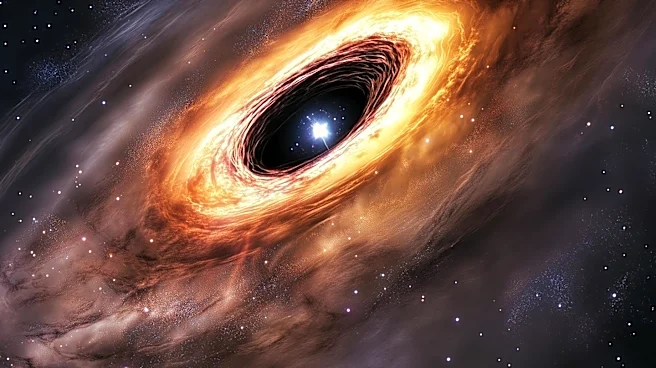
A new study published in Nature Astrophysics has identified a universal critical accretion rate for the formation of jets from both supermassive and stellar-mass black holes. The research indicates that for long-term jet formation, both types of black holes need
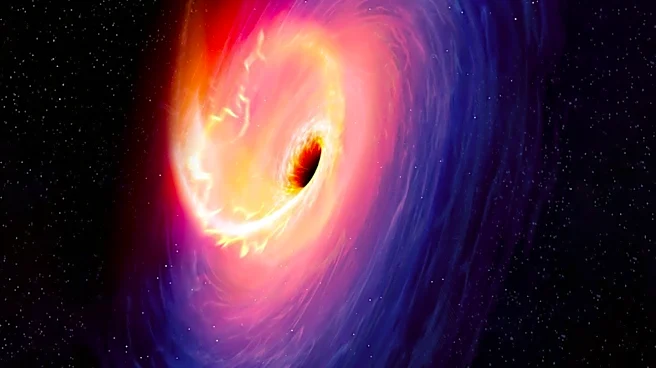
to consume matter at a rate of about 2% of the Eddington Limit. This finding suggests that the process of jet formation is scale-invariant. Stellar-mass black holes typically become active by stripping material from a companion star, while supermassive black holes gather material by ripping apart stars in Tidal Disruption Events (TDEs). While TDEs can generate tremendous X-rays and quickly produce initial jets, the study found that after a few years, these black holes also settle into the 2% Eddington Limit for sustained jet production. The research involved observing twenty TDEs across radio, visible, ultraviolet, and X-ray frequencies to determine matter consumption rates and jet formation.
Why It's Important?
This discovery is significant because it provides a unified understanding of jet formation across different scales of black holes. By establishing a universal critical accretion rate, scientists can use observations of stellar-mass black holes, which are more numerous and often closer, to better understand the dynamics of supermassive black holes, which are harder to study directly. This cross-scale understanding simplifies complex astrophysical models and enhances our ability to predict black hole behavior. The finding also sheds light on why some supermassive black holes generate jets even without bright TDEs, suggesting that the sustained accretion from their disks at the critical rate is the key factor. This improved understanding of jet mechanisms is vital for comprehending how black holes influence their galactic environments, including the distribution of matter and energy within galaxies.
What's Next?
Future research will likely delve deeper into the mechanisms behind this universal accretion rate and its implications for black hole evolution. Scientists may conduct more detailed observations of black holes at various stages of activity to confirm and refine the 2% Eddington Limit threshold. The study's findings could also lead to the development of more accurate simulations of black hole accretion disks and jet formation. Furthermore, understanding this critical rate could help in identifying inactive black holes that might become active in the future, or in predicting the longevity and intensity of existing jets. The ability to study stellar-mass black holes to infer properties of supermassive black holes opens new avenues for research, potentially accelerating discoveries in high-energy astrophysics and cosmology.
Beyond the Headlines
The concept of a universal critical accretion rate for black hole jets highlights a fundamental principle governing these extreme cosmic objects. It suggests an underlying elegance and simplicity in the universe's most powerful phenomena, where similar physical laws apply regardless of scale. This finding could have broader implications for our understanding of energy transfer and matter dynamics in the cosmos. The jets themselves are powerful conduits of energy, influencing star formation and galaxy evolution over vast distances. Understanding their formation mechanism is not just about black holes, but about the entire cosmic ecosystem. It underscores the interconnectedness of celestial objects and the intricate balance of forces that shape the universe, from the smallest stellar-mass black hole to the largest supermassive ones.