
What's Happening?
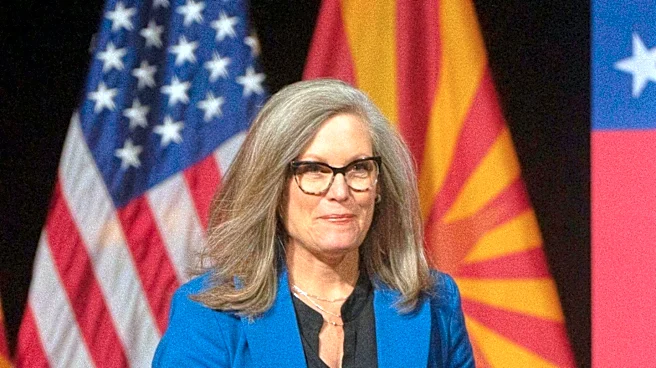
John Giles, the former Republican mayor of Mesa and now an independent, has been selected as Governor Katie Hobbs' running mate for the Democratic ticket. Giles asserts that there is no conflict between
his Republican past and his current role, stating that his policy differences with Hobbs are 'remarkably little or nothing.' He emphasizes a shared focus on non-partisan issues such as economic development, education, and public safety. Giles, despite identifying as pro-life, supported the 2024 ballot initiative that codified the right to abortion in the state constitution, citing the will of Arizona voters and the state's constitutional protections. He also supports school choice but advocates for increased funding for public schools, believing that a strong public option is essential for meaningful school choice. Giles has dismissed questions regarding his stance on transgender boys using girls' restrooms as a 'red herring,' referencing a 2021 ordinance he helped pass in Mesa that prohibits discrimination based on sexual orientation, gender, and gender identity, which he maintains has not compromised women's safety.
Why It's Important?
John Giles' embrace of Democratic positions as Governor Hobbs' running mate signifies a notable shift in Arizona's political landscape, particularly given his Republican background and subsequent switch to independent status. This move is crucial for Governor Hobbs' reelection campaign, as it aims to attract moderate and independent voters in a swing state with a significant Republican presence. Giles' nuanced stance on issues like abortion, where he supports the constitutional right despite personal pro-life views, reflects a pragmatic approach to align with voter sentiment and state law. His advocacy for both school choice and increased public school funding highlights a complex but potentially unifying perspective on education, seeking to balance different educational philosophies. By dismissing the transgender restroom issue as a 'red herring' and upholding anti-discrimination ordinances, Giles positions himself and the ticket as inclusive and focused on broader civil rights, potentially appealing to a diverse electorate while navigating contentious social issues. This alignment could reshape political discourse in Arizona, encouraging more cross-party collaboration on key policy areas.
What's Next?
As the November election approaches, John Giles' alignment with Governor Hobbs' Democratic platform will be a central theme of their campaign. They will likely continue to highlight their shared commitment to non-partisan issues and their ability to work across political divides. Giles' positions on education and social issues will be scrutinized by both supporters and opponents, and his ability to articulate these stances effectively will be crucial. The campaign will need to convince voters that his past Republican affiliation does not contradict his current role and that his independent status allows for a more effective, less partisan approach to governance. The Republican opposition, led by Andy Biggs and Sine Kerr, will likely challenge Giles' consistency and attempt to draw distinctions between his past and present political views. The outcome of this election will not only determine the leadership of Arizona but also serve as a barometer for the effectiveness of bipartisan strategies in highly contested states.
Beyond the Headlines
John Giles' political evolution from a Republican mayor to an independent running mate on a Democratic ticket in Arizona reflects a broader national trend of political fluidity and the increasing importance of independent voters. His ability to reconcile personal beliefs with public policy, particularly on contentious issues like abortion, suggests a pragmatic approach to governance that prioritizes the will of the electorate and constitutional mandates. This phenomenon challenges traditional party loyalties and could indicate a growing desire among voters for leaders who can transcend partisan divides. The emphasis on 'non-partisan issues' like economic development and public safety by both Hobbs and Giles underscores a potential shift in political campaigning, where candidates focus on tangible outcomes rather than ideological purity. This strategy could pave the way for more collaborative governance models, even in deeply divided political landscapes, by demonstrating that leaders from different backgrounds can unite on common goals. The success or failure of this bipartisan ticket in Arizona could offer valuable insights into the future direction of American politics.