
What's Happening?
NASA's Hubble Space Telescope has captured a striking image of NGC 6426, a globular cluster located in the outer halo of the Milky Way. This cluster, estimated to be around 13 billion years old, is one
of the oldest known in our galaxy. The image, released to commemorate the 250th anniversary of the United States, showcases a field of red, white, and blue stars, symbolizing the nation's history of exploration. The colors in the image represent different wavelengths of light, with blue indicating hotter stars and red cooler ones. The stars in NGC 6426 have low metallicity, meaning they contain fewer elements heavier than hydrogen and helium, reflecting the chemical composition of the early universe. This cluster provides a valuable record of conditions shortly after the universe's formation.
Why It's Important?
The study of NGC 6426 offers significant insights into the early universe's conditions and the formation of galaxies. By analyzing the chemical composition and age of such ancient star clusters, astronomers can better understand the processes that led to the formation of the Milky Way. The presence of two chemically distinct populations of stars within the cluster suggests a complex history of star formation and supernova events, which contributed to the enrichment of the universe with heavier elements. These findings are crucial for understanding the evolution of galaxies and the distribution of elements necessary for planet formation.
What's Next?
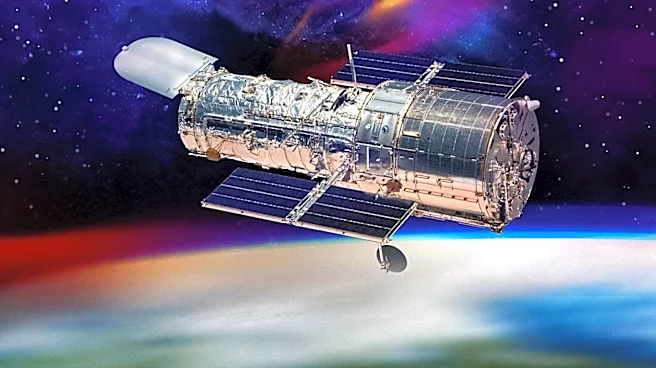
NASA continues to study globular clusters like NGC 6426 to unravel the history of the Milky Way. The Hubble Space Telescope, alongside the James Webb Space Telescope and the upcoming Nancy Grace Roman Space Telescope, will further enhance our understanding of the universe. These telescopes will provide complementary observations, allowing scientists to explore the cosmos in different wavelengths and gain deeper insights into the formation and evolution of galaxies.