






What's Happening?
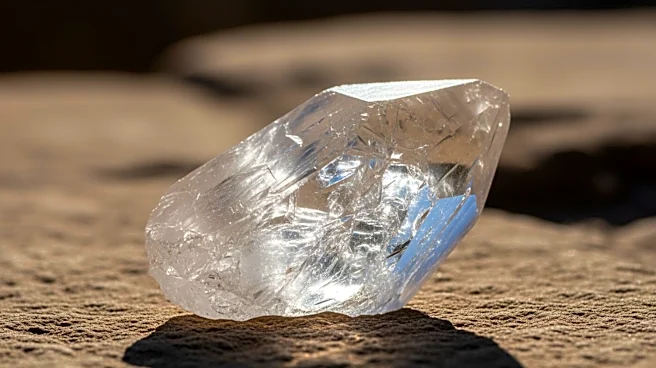
A recent study has investigated why the Clovis people, a well-documented late Pleistocene hunter-gatherer group in North America, chose to use quartz crystal for toolmaking despite its challenging properties. Quartz crystals are difficult to knap due
to their size, hardness, and crystalline structure, making them a 'low-quality' raw material compared to others like chert and obsidian. Dr. Briggs Buchanan and his team conducted scaling and geometric morphometric analyses on Clovis crystal points to determine their functional comparability to those made from higher-quality materials. The study found that quartz crystal points were similar in size and shape to other Clovis points, suggesting that the Clovis deliberately chose this material, possibly for its symbolic or ritual significance.
Why It's Important?
The study's findings highlight the Clovis people's advanced skill in toolmaking, as they were able to overcome the challenges of using quartz crystal. This choice may reflect cultural or symbolic values, as quartz crystals have been historically regarded as having special properties in various societies. Understanding the Clovis' material choices provides insights into their technological organization and cultural practices. The research also suggests that raw material quality did not dictate Clovis point design, indicating a sophisticated level of craftsmanship and adaptability.
What's Next?
Future research aims to expand the scaling methodology to other Clovis points made from different materials, both low and high quality, to explore trends in size, shape, and function. This could further illuminate the technological strategies of the Clovis people and their ability to adapt to available resources. The study opens avenues for understanding the intersection of functional and symbolic uses of materials in ancient societies.