
What's Happening?
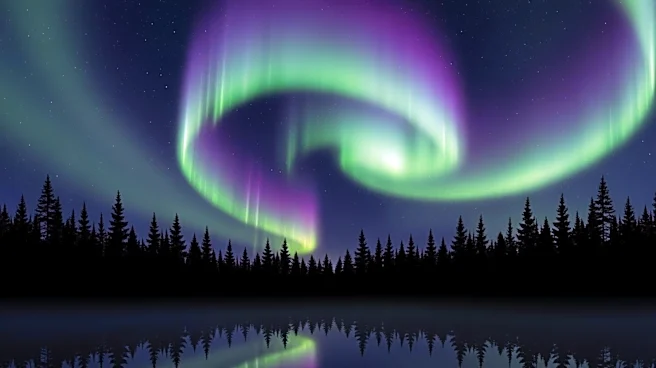
The National Oceanic and Atmospheric Administration (NOAA) has forecasted that the northern lights, or aurora borealis, will be visible across several northern U.S. states on May 14 and 15. This natural
phenomenon is expected to be observable due to increased geomagnetic activity, which is predicted to peak between 11 p.m. and 2 a.m. local time. The states likely to experience this spectacle include Washington, Idaho, Montana, North Dakota, Minnesota, Michigan, and Wisconsin. The aurora borealis occurs when electrically charged particles from the sun collide with gases in Earth's atmosphere, creating colorful displays in the sky. The visibility of these lights depends on the strength of the geomagnetic storm, which could reach levels that allow the auroras to be seen further south than usual.
Why It's Important?
The visibility of the northern lights in the U.S. is a rare and significant event, drawing interest from both the scientific community and the general public. This occurrence provides an opportunity for educational engagement regarding space weather and its effects on Earth. Additionally, it can boost local tourism in areas where the lights are visible, as enthusiasts and photographers travel to witness the event. The phenomenon also highlights the importance of monitoring solar activity and understanding its potential impacts on Earth's magnetic field and technological systems.
What's Next?
As the geomagnetic activity continues, NOAA will provide updated forecasts to help observers plan their viewing experiences. Enthusiasts are advised to find dark locations away from city lights to maximize their chances of seeing the auroras. The event may also prompt further research into solar activity and its interactions with Earth's atmosphere, contributing to the broader understanding of space weather phenomena.