
What's Happening?
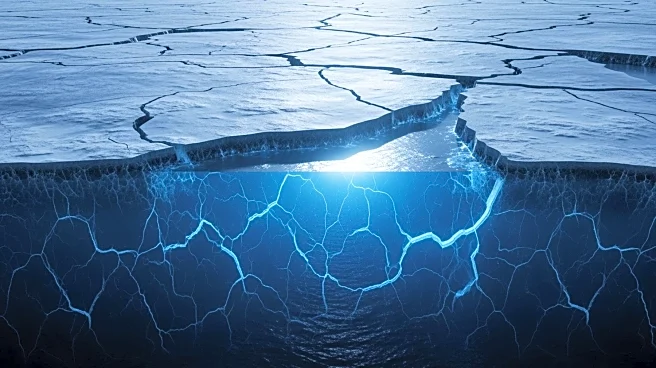
A new study has modeled the ocean floor of Jupiter's moon Europa, suggesting a lack of tectonic activity, which could reduce the moon's potential to support life. The study, led by Paul Byrne from Washington
University in St. Louis, indicates that without tectonic faulting, fresh rock exposure necessary for chemical reactions that sustain life is unlikely. Europa's ocean, hidden beneath a thick ice shell, wraps around a rocky core, but the interface between the ocean and core remains poorly understood. The study suggests that tidal stresses and other factors are insufficient to induce tectonic activity, which is crucial for nutrient supply through hydrothermal vents.
Why It's Important?
The findings challenge the notion of Europa as a prime candidate for extraterrestrial life within our solar system. Tectonic activity is a key driver of chemical processes that could support life, and its absence on Europa could mean fewer opportunities for life to exist. This has implications for future missions and the search for life beyond Earth, as it may shift focus to other celestial bodies with more favorable conditions. The study also raises questions about the potential for life on other ocean moons in the solar system.
What's Next?
NASA's Europa Clipper mission, set to explore Europa, aims to gather more data on the moon's ice shell and ocean. The mission could provide insights into the presence of alternative energy sources or pathways for nutrient exchange. Researchers will continue to study other ocean moons to assess their potential for life, with particular interest in Saturn's moon Enceladus, which may have more favorable conditions.