







What's Happening?
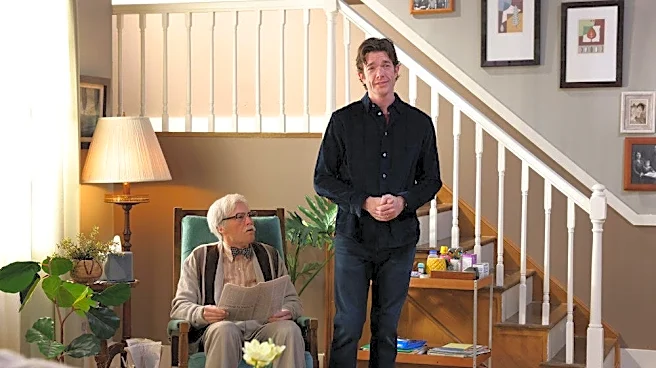
A recent 'Saturday Night Live' (SNL) pre-recorded sketch titled 'Sister' has resonated deeply with audiences, particularly women, by satirizing the disproportionate burden of elder caregiving placed on female family members. The sketch features comedian
John Mulaney pitching a fictional service called 'Sister,' which instantly activates a man's actual sister to quit her job, break her lease, and move across the country to provide free, 24-hour care for an elderly parent. The segment humorously, yet pointedly, illustrates how 'internalized sexism' leads sisters to believe caretaking is solely their responsibility. Dr. Donna Benton, director of the USC Family Caregiver Support Center, reported being inundated with responses after the sketch aired, noting that her research consistently shows a 70-30 split in caregiving responsibilities, with women handling the majority. The sketch also critiques systemic issues, such as the difficulty of navigating complex healthcare systems and the underfunding of social services, which further exacerbate the challenges faced by caregivers.
Why It's Important?
The SNL sketch brings to the forefront a critical national issue: the ongoing crisis in elder caregiving and its profound impact on women. This comedic portrayal underscores the 'daughter tax,' a phenomenon where women disproportionately sacrifice their careers, financial stability, and personal well-being to care for aging parents. Research indicates that daughters spend more than twice as much time caring for elderly parents as sons, averaging 12.3 hours per month compared to 5.6 hours for sons. This imbalance leads to significant financial and emotional tolls on female caregivers, who often face lost wages, reduced retirement savings, and compromised physical and mental health. The sketch's viral reception and the subsequent public discussion highlight a societal expectation that women are inherently more nurturing and thus responsible for caregiving, even in the absence of adequate systemic support or equitable family contributions. The conversation sparked by SNL could potentially galvanize efforts to address these disparities and push for policy changes.
What's Next?
The widespread resonance of the 'Sister' sketch could serve as a catalyst for broader national conversations and potential policy advocacy regarding elder care. Experts like Dr. Donna Benton hope the sketch will prompt discussions on how to address the systemic issues and gender inequalities in caregiving. Organizations like AARP are already urging Congress to consider measures such as tax credits for out-of-pocket caregiving expenses, which average over $11,500 annually for families. There may be increased pressure on policymakers to develop a comprehensive national long-term care strategy, as the current system is deemed unsustainable, especially with an aging population. Additionally, the sketch might encourage families to have proactive conversations about caregiving responsibilities and equitable distribution of tasks before a crisis arises, fostering a team-based approach rather than defaulting to traditional gender roles.
Beyond the Headlines
Beyond the immediate humor and social commentary, the SNL sketch illuminates deeper ethical and societal implications concerning gender roles, economic equity, and the value placed on care work. The 'daughter tax' is not merely a personal burden but a significant economic drain on women, impacting their lifetime earnings, retirement security, and overall financial independence. The sketch implicitly questions why caregiving, often unpaid and undervalued, is predominantly seen as a female responsibility, reflecting ingrained societal biases. Furthermore, the critique of complex, underfunded social service systems points to a broader failure in public policy to support an aging population and their caregivers. This situation raises ethical questions about collective responsibility for elder care and whether society adequately supports those who provide essential, often invisible, labor. The long-term shift could involve a re-evaluation of caregiving as a societal rather than solely familial responsibility, potentially leading to more robust public support systems and a more equitable distribution of care duties.