


What's Happening?
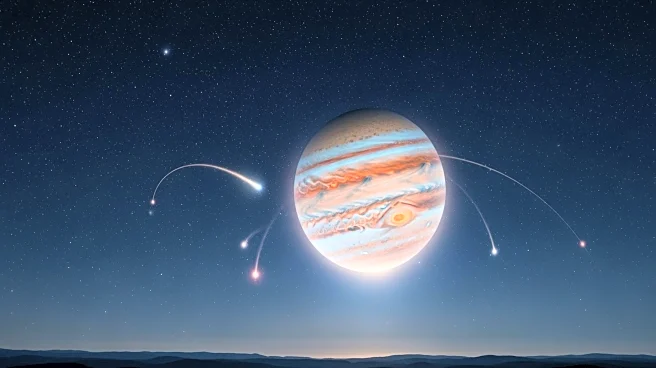
The latest celestial observations highlight Jupiter's prominent position in the night sky as it moves westward, or retrograde, against the starry background. This movement is leading up to its opposition on January 10th. Jupiter's position has shifted
noticeably from the line between Pollux and Procyon, making it a key feature for astronomers and stargazers. Additionally, the New Moon occurs on December 19th, and the winter solstice marks the longest night of the year on December 21st. Other notable celestial events include the visibility of the Andromeda Galaxy, the conjunction of the Moon and Saturn, and the appearance of the Hyades cluster. These events provide opportunities for both amateur and seasoned astronomers to engage with the night sky.
Why It's Important?
These celestial events are significant for astronomers and enthusiasts as they offer a chance to observe and study planetary movements and star formations. Jupiter's retrograde motion and upcoming opposition provide a unique opportunity to observe the planet at its brightest and largest in the sky. The winter solstice, marking the longest night, allows for extended observation periods. The visibility of the Andromeda Galaxy and the Hyades cluster offers educational opportunities for those learning about constellations and deep-sky objects. These events also foster public interest in astronomy, encouraging people to explore the night sky and understand the dynamics of celestial bodies.
What's Next?
As Jupiter approaches its opposition on January 10th, it will continue to be a focal point for observation, offering clear views for telescopic study. The conjunction of the Moon and Saturn on December 26th will be another highlight, providing a striking visual for observers. The ongoing visibility of the Andromeda Galaxy and the Hyades cluster will continue to attract interest from stargazers. These events may lead to increased participation in astronomy clubs and educational programs, as well as inspire new enthusiasts to invest in telescopes and other observational tools.
Beyond the Headlines
The current celestial events underscore the importance of understanding astronomical phenomena and their impact on our perception of the universe. Observing these events can enhance public appreciation for science and the natural world, potentially influencing educational curricula and public policy related to science education. The fascination with celestial events can also drive technological advancements in telescopic equipment and imaging technology, furthering our ability to explore and understand the cosmos.