
What's Happening?
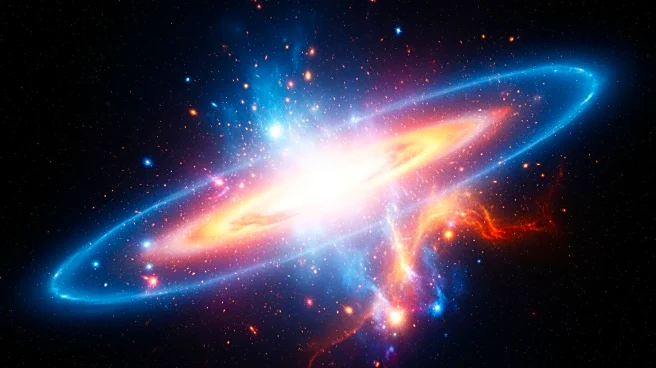
Astronomers have uncovered unusually high levels of chlorine and potassium in the supernova remnant Cassiopeia A, challenging existing models of how these life-essential elements are formed. Using Japan's
XRISM satellite, researchers from Kyoto University and Meiji University conducted precise X-ray spectroscopy to detect these elements in quantities far exceeding theoretical predictions. This discovery suggests that supernovae can produce key elements tied to life, with Cassiopeia A alone generating amounts comparable to those observed across the galaxy. The findings, published in Nature Astronomy, indicate that the star experienced strong internal mixing before its explosion, possibly due to rotation or binary interactions.
Why It's Important?
The presence of chlorine and potassium in such high quantities is significant because these elements play crucial roles in biological processes, including cellular balance and atmospheric chemistry. The study bridges a gap between theoretical models and actual cosmic measurements, enhancing our understanding of how the universe creates the elements necessary for life. This discovery also suggests that the conditions leading up to a star's collapse, such as its rotation and internal structure, influence the availability of elements that eventually contribute to planetary formation and life. The research underscores the interconnectedness of stellar evolution and the chemical conditions that allowed Earth to form.
What's Next?
Researchers plan to use XRISM to examine additional supernova remnants to determine if Cassiopeia A is an anomaly or part of a broader pattern. Establishing such a pattern could refine models of stellar activity and its impact on the chemical composition of galaxies. Future missions and deeper observations may reveal more odd-Z elements, like phosphorus, providing a more comprehensive understanding of the cosmic 'recipe list' that predates life. This ongoing research aims to connect stellar evolution more directly to the conditions that enabled life on Earth.