







What's Happening?
A new report co-authored by a UC Riverside water expert advises California's governor-elect, Xavier Becerra, to make flood and drought preparedness a top priority. The report, titled 'Priorities for California’s Water: Advice for the Incoming Governor,'
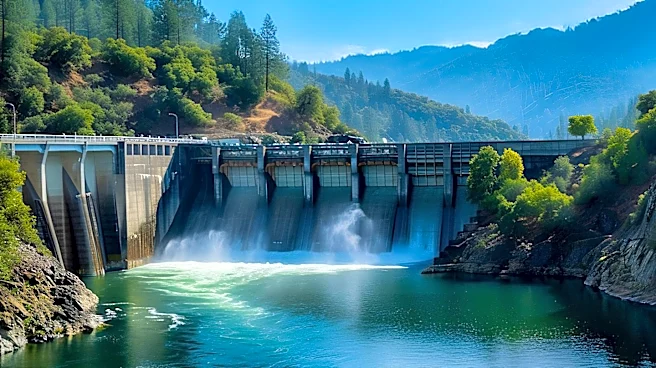
highlights the state's water system vulnerability due to climate change, excessive groundwater pumping, and neglected infrastructure. Prepared by the Public Policy Institute of California’s Water Policy Center, the document recommends enhanced disaster preparedness, stronger groundwater protections, and long-term investments in water storage and delivery systems. According to UCR public policy professor Kurt Schwabe, a co-author, California's current water conveyance and storage systems are undersized for modern flood and drought conditions. An immediate concern is preventing further damage to the State Water Project’s canals from land subsidence in the Central Valley, caused by excessive groundwater pumping, which can severely reduce water delivery capacity.
Why It's Important?
California's water challenges are compounded by its geography, with 75% of the water supply originating north of Sacramento and 75% of demand located to the south. The state's extensive network of dams, canals, and aqueducts, largely built decades ago, was designed for more predictable Sierra Nevada snowfall patterns. Climate change is disrupting this system by increasing rainfall over snow and causing extreme weather fluctuations between wet and dry periods. The report emphasizes that continued land subsidence from groundwater pumping could reduce the State Water Project’s long-term delivery capacity by up to 87% over two decades, posing a significant threat to agricultural and urban water supplies. The economic impact of floods, which have caused approximately $8 billion in damages and 29 deaths since 2012, underscores the urgent need for improved disaster preparedness and infrastructure resilience.
What's Next?
The report outlines three broad priorities for the incoming governor: disaster preparedness, stronger groundwater protections, and long-term investments in water storage and delivery systems. For disaster preparedness, recommendations include updated flood protection standards, better emergency communications, clearer lines of authority, and infrastructure upgrades to withstand severe storms. Regarding groundwater, the report calls for stricter implementation of California’s Sustainable Groundwater Management Act, enacted in 2014, through tighter pumping controls, improved accounting, and streamlined permits for underground floodwater storage. Finally, long-term investments are urged for better water supply measurement, dependable infrastructure financing, and restoration of natural systems to absorb floodwaters. These measures require sustained commitment beyond a single gubernatorial term to ensure California's water security.
Beyond the Headlines
The underlying issues highlighted in the report point to a critical need for a paradigm shift in California's water management strategy. The reliance on outdated infrastructure and water rights systems, coupled with the accelerating impacts of climate change, creates a complex challenge. The report implicitly suggests that current economic models for water do not adequately account for the true costs of scarcity and disaster. Addressing these issues will require not only significant financial investment but also a re-evaluation of water governance, potentially leading to reforms in how water is allocated and managed across different sectors. The long-term health of California's agricultural industry, a major contributor to the U.S. economy, and the well-being of its urban populations are directly tied to the state's ability to adapt to these evolving water realities.