





What's Happening?
A recent study has investigated the impact of demolishing informal settlements on urban land surface temperatures in major Chinese cities. Using a quasi-natural experiment and difference-in-differences analysis, researchers examined 661 informal settlements in Beijing,
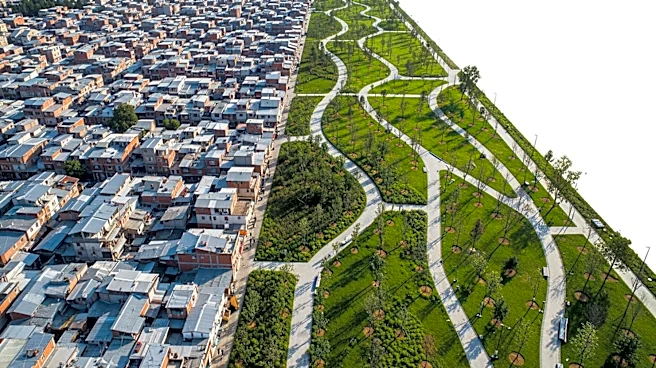
Shanghai, and Guangzhou from 2002 to 2022. The study found that demolition led to significant cooling effects, with an average temperature decrease of 1.47 K across all cities. Beijing experienced the most pronounced cooling, attributed to its semi-arid climate and urban planning regulations that promote green spaces. The study highlights the role of redevelopment in transforming dense informal settlements into formal neighborhoods, contributing to lower local temperatures.
Why It's Important?
The findings underscore the potential environmental benefits of urban renewal projects, particularly in reducing heat in densely populated areas. As cities worldwide grapple with the challenges of climate change and urbanization, understanding the cooling effects of redevelopment can inform sustainable urban planning strategies. The study also highlights the importance of considering local climate conditions and urban geography in designing effective interventions. By transforming informal settlements into formal neighborhoods with green spaces, cities can mitigate the urban heat island effect and improve living conditions for residents.
What's Next?
The study's results may encourage policymakers and urban planners to prioritize the demolition and redevelopment of informal settlements as part of broader climate adaptation strategies. Future research could explore the long-term impacts of such projects on urban ecosystems and social dynamics. Additionally, cities may consider integrating cooling mechanisms, such as increased vegetation and open spaces, into redevelopment plans to maximize environmental benefits.
Beyond the Headlines
The demolition of informal settlements raises questions about the social and economic implications for displaced residents, many of whom face challenges related to property rights and access to services. Ensuring equitable redevelopment that addresses the needs of affected communities is crucial to avoid exacerbating existing inequalities. The study also highlights the potential for urban renewal projects to contribute to broader climate resilience efforts, emphasizing the need for interdisciplinary approaches that consider environmental, social, and economic factors.