



What's Happening?
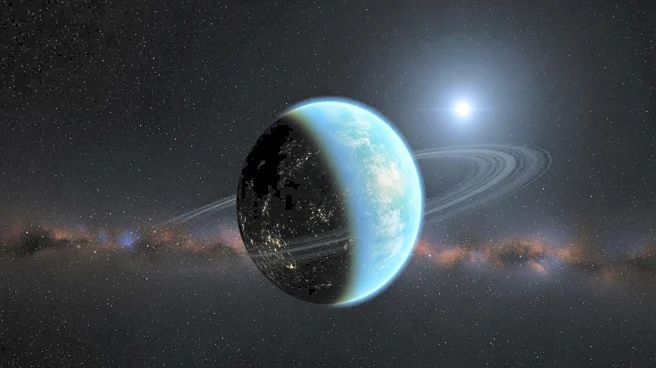
Astronomers have discovered a third exoplanet in the HD 176986 system, a K-type star located 91 light years from Earth. Using the HARPS and HARPS-N spectrographs, the team identified the new planet, HD 176986 d, which orbits the star every 61.38 days.
This discovery adds to the previously known super-Earths, HD 176986 b and c, and highlights the capabilities of radial velocity surveys in detecting planets with longer orbital periods. The new planet has a minimum mass of 6.76 Earth masses and an equilibrium temperature of 363 K.
Why It's Important?
The discovery of HD 176986 d enhances our understanding of planetary systems around K-type stars, which are considered potential hosts for habitable planets. This finding demonstrates the effectiveness of long-term radial velocity surveys in exploring the habitable zones of stars, contributing to the search for life beyond Earth. The research also refines the parameters of the known planets in the system, providing valuable data for future studies on planetary formation and dynamics.
What's Next?
Further observations and studies of the HD 176986 system could provide insights into the formation and evolution of super-Earths. The continued use of advanced spectrographs and observational techniques will likely lead to more discoveries in similar systems, expanding our knowledge of exoplanetary environments. Researchers may also explore the potential habitability of these planets, considering their proximity to the host star and atmospheric conditions.