




What's Happening?
Astronomers using NASA’s Chandra X-ray Observatory have identified the cause of repeated, mysterious outbursts from a giant, unstable star known as AT 2016blu. The star, located in the spiral galaxy NGC 4559 approximately 30 million light-years from Earth,
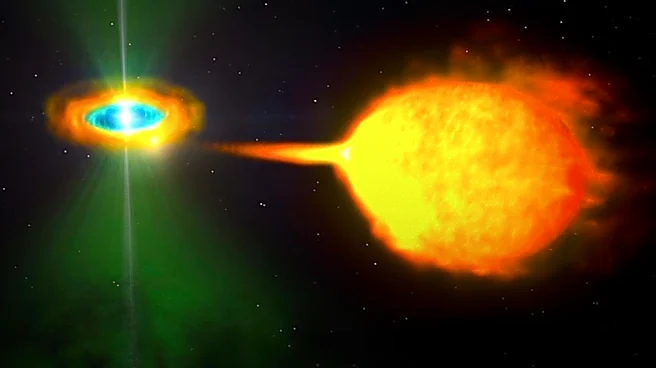
is a luminous blue variable with a mass at least 33 times that of the Sun. For 15 years, AT 2016blu has exhibited regular increases in brightness, resembling supernova explosions but without the star's destruction, earning it the moniker 'supernova impostor.' The new study, published in The Astrophysical Journal, reveals a previously hidden companion object—either a stellar-mass black hole or a neutron star—that orbits AT 2016blu every 113 days. During their closest approach, the companion pulls material from the massive star, which then heats up to extreme temperatures and emits bright X-rays, causing the observed optical outbursts.
Why It's Important?
This discovery marks the first X-ray detection of this class of erupting stars and the first time such an object has been found with a black hole or neutron star companion. It provides a crucial explanation for the perplexing behavior of 'supernova impostors' and offers new insights into the dynamics of binary star systems involving compact objects. The intense X-ray emissions classify AT 2016blu as a candidate ultra-luminous X-ray source (ULX), a rare and poorly understood class of objects. Understanding the mechanism behind these outbursts could help astronomers unravel the nature of ULXs and their potential connection to violent stellar eruptions. Furthermore, this research contributes to the broader study of stars that undergo significant brightness changes before supernova explosions, suggesting that many such behaviors might be driven by interactions within binary systems.
What's Next?
Astronomers will continue to study AT 2016blu and similar systems to further understand the interplay between massive stars and their compact companions. The findings suggest a potential link between ULXs and these erupting stars, prompting further investigation into the characteristics and evolution of ULXs. Future observations will aim to precisely determine the nature of the companion object (black hole or neutron star) and to model the accretion process in greater detail. This research will also inform studies of other variable stars and their pre-supernova behavior, potentially leading to a better understanding of stellar death and the formation of compact objects. The use of advanced X-ray observatories like Chandra will remain essential for these investigations.
Beyond the Headlines
The identification of a compact companion driving the outbursts of AT 2016blu highlights the complex and often violent interactions that occur in binary star systems. These systems are cosmic laboratories where extreme physics, such as intense gravitational forces and high-energy radiation, can be observed. The discovery also underscores the power of multi-wavelength astronomy, combining optical and X-ray data, to uncover hidden phenomena in the universe. The 'supernova impostor' phenomenon itself challenges our definitions of stellar evolution and death, revealing that some stars can undergo dramatic, repetitive eruptions without being destroyed. This ongoing cosmic drama provides a window into the fundamental processes that shape galaxies and the objects within them.