


What's Happening?
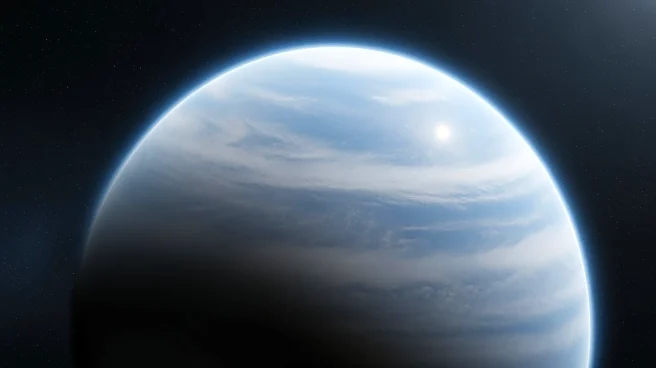
Researchers using NASA's James Webb Space Telescope (JWST) have studied Kepler-51d, an exoplanet wrapped in an unusually dense layer of haze. This haze is the thickest ever detected on a planet, making it difficult to identify the chemical makeup of its
atmosphere or trace its origins. Kepler-51d is part of a rare class of ultra-low-density worlds known as super-puffs, which defy conventional understanding of gas giant formation. The planet lacks a dense core and orbits at a distance from its star comparable to Venus's position relative to the sun.
Why It's Important?
The study of Kepler-51d challenges existing models of planet formation, particularly for gas giants. Understanding the composition and formation of super-puff planets could provide insights into the diversity of planetary systems and the conditions that allow for the development of unique worlds. The findings may influence future research on exoplanet atmospheres and the search for habitable environments beyond our solar system.
What's Next?
Further observations are needed to determine the composition of Kepler-51d's atmosphere and the extent of its haze layer. Researchers are analyzing JWST data from another planet in the same system, Kepler-51b, to explore whether all super-puff planets share similar atmospheric characteristics. This could lead to new discoveries about the formation and evolution of these rare exoplanets.
Beyond the Headlines
The study of Kepler-51d highlights the challenges faced by astronomers in understanding the diversity of exoplanets. It raises questions about the processes that lead to the formation of super-puff planets and their potential for hosting life. This could have implications for the development of new technologies and methods for studying distant worlds.