


What's Happening?
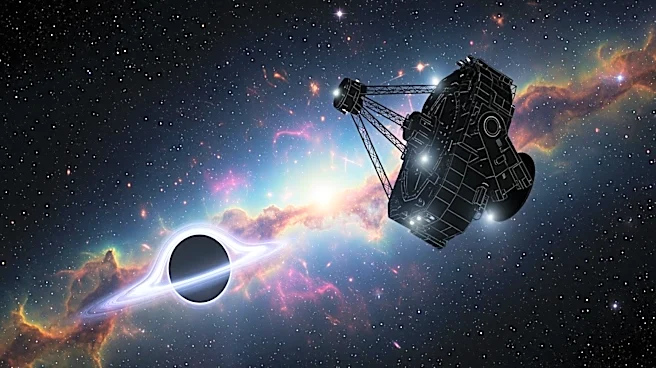
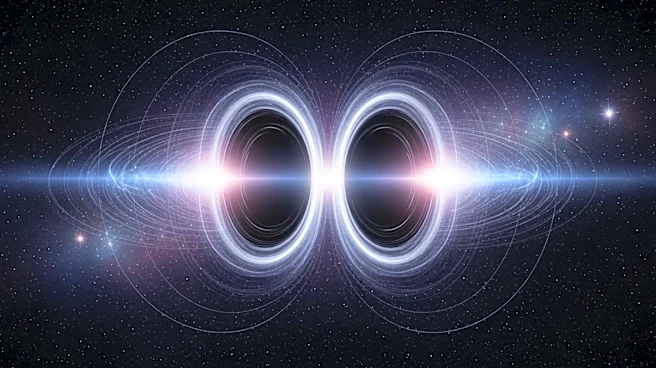
Astronomers have discovered a significant number of black hole mergers, described as a 'lost world,' through the analysis of gravitational waves. The Gravitational Wave Transient Catalogue-5.0 (GWTC-5) has revealed 161 new gravitational wave signals from
merging black holes, detected by LIGO, Virgo, and KAGRA between April 2024 and January 2025. This brings the total number of detected black hole mergers to 390. The catalog includes 'second generation mergers,' where black holes formed from previous mergers collide, and the most precisely localized merger to date. These findings could enhance understanding of black hole growth and the universe's expansion rate.
Why It's Important?
The discovery of numerous black hole mergers has significant implications for astrophysics and cosmology. It provides insights into the formation and evolution of black holes, potentially revealing new pathways for their creation beyond massive binary stars. The precise localization of mergers could help refine measurements of the universe's expansion rate, known as the Hubble constant, which is crucial for understanding cosmic evolution. Additionally, the findings support theories like Stephen Hawking's black hole area theorem, confirming that thermodynamic laws apply to black holes. This research could lead to advancements in gravitational wave astronomy and deepen our comprehension of the universe's most violent events.
What's Next?
The gravitational wave detectors LIGO, Virgo, and KAGRA are set to continue their observations, with a six-month intermediate run planned later this year. This will bridge the gap between the end of Observing Run 4 and the start of Observing Run 5, scheduled for 2028 to 2031. These future observations are expected to yield more discoveries, further expanding our understanding of black holes and the universe. Researchers anticipate that ongoing advancements in detector sensitivity will lead to more frequent detections, enhancing the precision of cosmological measurements and potentially uncovering new phenomena.
Beyond the Headlines
The implications of these discoveries extend beyond immediate scientific insights. They challenge existing models of black hole formation and growth, suggesting complex merger chains in densely packed stellar environments. The ability to precisely localize gravitational wave signals opens new avenues for exploring cosmic phenomena and testing fundamental physics theories. As gravitational wave astronomy evolves, it may redefine our understanding of the universe's structure and dynamics, offering a deeper glimpse into the nature of spacetime and the forces shaping cosmic history.