




What's Happening?
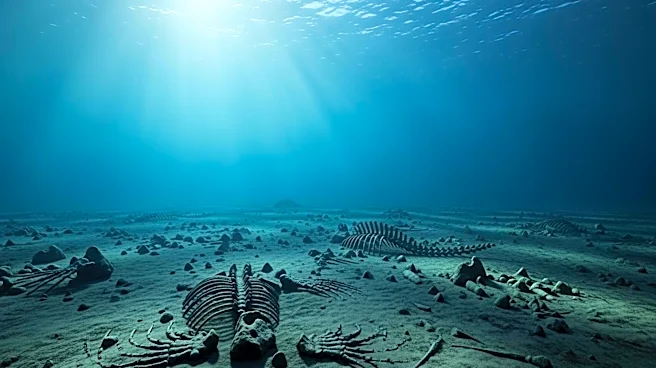
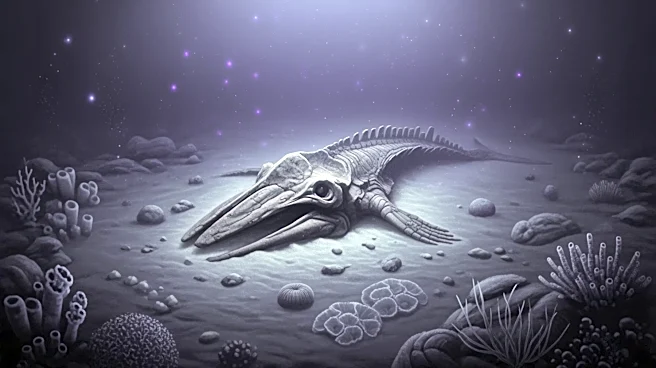
Researchers from the Institute of Deep-sea Science and Engineering (IDSSE) have uncovered the world's deepest and largest aggregation of whale fossils and active whale-fall ecosystems in the Diamantina Zone of the southeastern Indian Ocean. This site,
referred to as a 'whale necropolis,' contains evidence of cetacean falls for at least 5.3 million years. The study, published in Nature, extends the known depth range of whale-fall ecosystems to nearly 7,000 meters. The discovery includes a large number of whale remains, with a density reaching up to 759.5 individuals per square kilometer, suggesting the presence of over 10 million whale carcasses. This represents a significant carbon sink, with approximately 6.7 million tons of sequestered carbon. The findings provide new insights into the evolution and dispersal of deep-sea life and the role of whale falls in carbon sequestration.
Why It's Important?
The discovery of this whale necropolis is significant for understanding deep-sea ecosystems and their role in carbon sequestration. Whale falls create localized biodiversity hotspots and contribute to long-term carbon storage, which is crucial in the context of climate change. The findings also enhance knowledge of the evolutionary history and biogeography of deep-sea life, offering insights into the connectivity of chemosynthetic communities. This research could inform conservation strategies and deepen understanding of marine carbon cycles, potentially influencing policies related to ocean conservation and climate change mitigation.