



What's Happening?
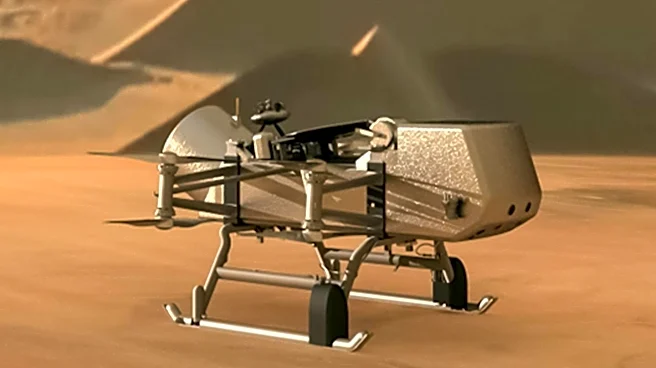
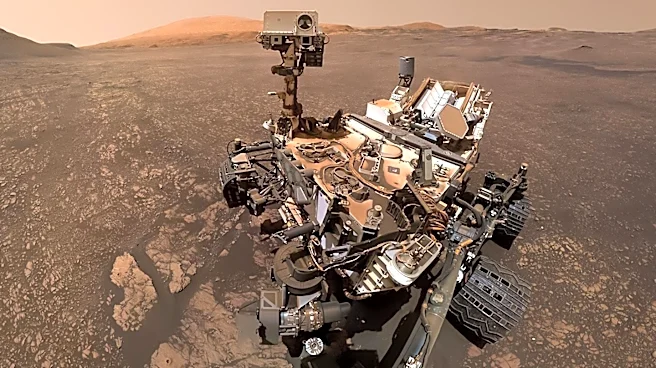
NASA's upcoming Dragonfly mission will deploy a flying robot, similar in size to the Mars Perseverance rover, to explore Saturn's moon, Titan. Scheduled for launch in July 2028 with an anticipated arrival in late 2034, Dragonfly will use eight rotors
in a quadcopter arrangement to navigate Titan's surface. This approach is designed to overcome the challenges of Titan's dense atmosphere, low gravity (approximately 1/7th of Earth's), and frigid temperatures, which make traditional wheeled traversal difficult. Dragonfly is expected to weigh around 1,900 pounds and will be capable of covering distances in minutes that would take Mars rovers an Earth year. The mission aims to collect data over three years, making one flight every 1-2 Titan days (about 16 Earth days).
Why It's Important?
The Dragonfly mission represents a significant shift in planetary exploration strategies, moving beyond traditional rovers to aerial vehicles for certain celestial bodies. Titan's unique environment, with its thick atmosphere and low gravity, makes it an ideal candidate for this type of exploration, allowing for greater mobility and access to diverse terrains. This mission is crucial for understanding prebiotic chemistry and the potential conditions of early Earth, as Titan possesses clouds, rain, lakes, and rivers, albeit composed of hydrocarbons like liquid methane and ethane. The data collected will help scientists assess the habitability of Titan and identify potential chemical biosignatures. For U.S. space exploration, the success of Dragonfly could validate aerial exploration as a viable and highly effective method for future missions to other moons, planets, and asteroids where conventional rovers might struggle.
What's Next?
Following its launch in July 2028, Dragonfly is expected to arrive on Titan in late 2034. Upon arrival, the robot will commence its three-year mission, making regular flights to various geological sites, including the equatorial region of Shangri-La with its 300-foot dunes. Dragonfly will collect surface samples and analyze them to study prebiotic chemistry, monitor Titan's methane cycle, weather patterns, and geological modifications. The mission's progress will be closely watched by the scientific community, as its success could influence the design and implementation of future planetary exploration missions. The insights gained will contribute to a broader understanding of the conditions necessary for life and the evolution of planetary systems, potentially leading to new scientific discoveries and technological advancements in aerospace engineering.
Beyond the Headlines
The Dragonfly mission's innovative approach to exploration on Titan has broader implications for how humanity conceives of and executes space missions. By demonstrating the efficacy of aerial mobility in an extraterrestrial environment, it challenges the conventional wisdom of ground-based exploration. This could open up new avenues for exploring worlds with challenging surfaces or atmospheres, expanding the reach of scientific inquiry. Furthermore, the mission's focus on prebiotic chemistry and the potential for life on Titan touches upon fundamental questions about the origins of life in the universe. The success of Dragonfly could inspire a new generation of scientists and engineers, fostering innovation in robotics, autonomous systems, and astrobiology, and reinforcing the U.S.'s leadership in space exploration.