





What's Happening?
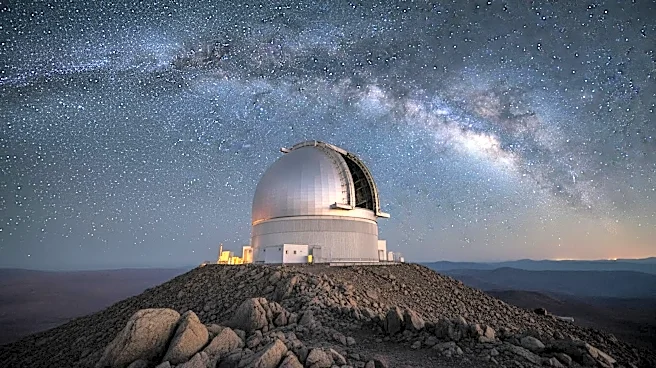
The Vera C. Rubin Observatory in Chile has commenced its 10-year Legacy Survey of Space and Time (LSST), marking the start of the largest cosmic time-lapse project in history. Utilizing the world's largest digital camera, the observatory will scan the southern
sky every few nights, capturing high-definition images to study cosmic phenomena. The project aims to explore dark energy, dark matter, and transient cosmic events like supernovae and gamma-ray bursts. Funded by the U.S. National Science Foundation and the Department of Energy, the observatory's findings could provide critical insights into the universe's expansion and the nature of dark energy.
Why It's Important?
The Rubin Observatory's project represents a significant advancement in astronomical research, with the potential to answer fundamental questions about the universe. By distinguishing between competing theories of dark energy, the project could reshape our understanding of cosmic expansion and gravity. The observatory's ability to detect new asteroids and transient events also enhances our capacity to monitor potential threats to Earth and study cosmic phenomena. This initiative underscores the importance of international collaboration and investment in scientific research to address complex questions about the universe.
What's Next?
Over the next decade, the Rubin Observatory will continue to collect and analyze data, with scientists anticipating breakthroughs in understanding dark energy and cosmic events. The project's findings could influence future astronomical research and inform theoretical models of the universe. As data accumulates, the scientific community will likely engage in extensive analysis and debate, potentially leading to new discoveries and hypotheses. The observatory's work may also inspire further technological advancements in telescope design and data processing.