
What's Happening?
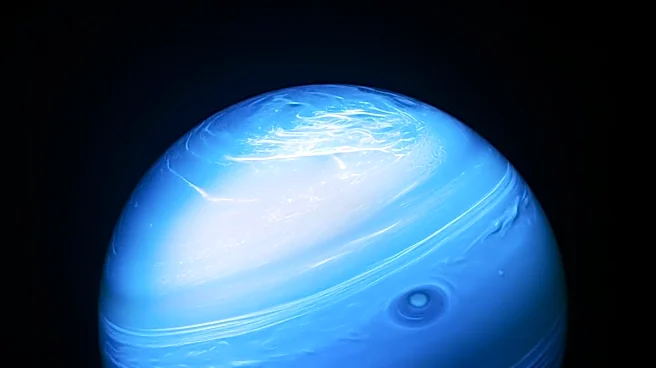
Neptune, located 4.5 billion kilometers from the Sun, experiences winds exceeding 2,000 kilometers per hour, despite receiving only a fraction of the sunlight Earth does. This phenomenon makes Neptune a unique
subject for studying planetary weather. The planet emits more energy than it absorbs from the Sun, suggesting internal heat plays a significant role in driving its weather patterns. Rapid rotation and atmospheric dynamics further contribute to the formation of powerful east-west jets. However, the exact mechanisms behind these extreme winds remain a topic of scientific inquiry.
Why It's Important?
Understanding Neptune's weather systems can provide insights into atmospheric dynamics that are applicable to other planets, including Earth. The study of such extreme conditions challenges existing models and theories, potentially leading to advancements in planetary science. Neptune's winds, driven by internal heat rather than solar energy, offer a unique perspective on how different energy sources can influence atmospheric behavior. This knowledge could inform future explorations and the search for habitable conditions on other planets.