








What's Happening?
The European Investment Bank (EIB) and the Nordic Investment Bank (NIB) are jointly providing €30 million in long-term financing for a new, energy-efficient education and community facility in Espoo, Finland. Each bank will contribute €15 million to Espoon
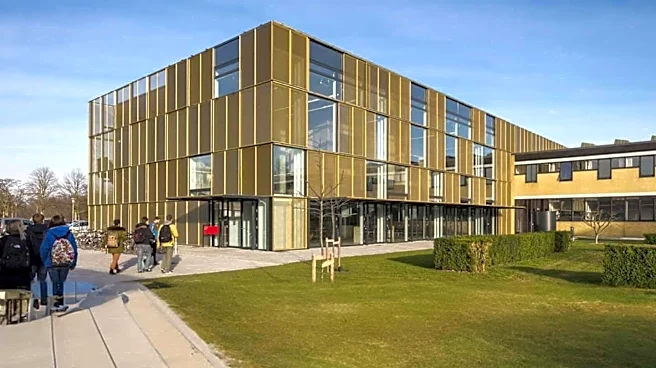
Koulutaival Oy, a project company managed by infrastructure investor Meridiam. This funding will support the construction of the Jupperi multipurpose building, a 7,200 m² complex designed to house primary education, daycare, sports facilities, a library, and various community services. The new facility is expected to accommodate approximately 600 pupils and is part of the City of Espoo’s 'Schools in Shape initiative,' which aims to modernize educational infrastructure to meet population growth and evolving educational needs. The EIB's financing for this project is further supported by the InvestEU program, a European Union initiative designed to mobilize significant private and public funds for sustainable recovery and strategic priorities.
Why It's Important?
This investment underscores a broader European commitment to sustainable social infrastructure and high energy-efficiency standards in public buildings. By financing projects like the Jupperi multipurpose building, the EIB and NIB are not only addressing immediate educational and community needs but also promoting long-term environmental sustainability. The 'Schools in Shape initiative' in Espoo highlights a proactive approach to urban development, ensuring that growing populations have access to modern, healthy, and accessible learning environments. The involvement of InvestEU signifies a strategic effort by the European Union to leverage public financing to attract private investment, thereby accelerating the delivery of essential social infrastructure. This model of blended finance can serve as a blueprint for other regions facing similar challenges in upgrading public facilities while adhering to ambitious environmental goals, contributing to overall societal well-being and economic resilience.
What's Next?
The construction of the Jupperi multipurpose building will proceed with the aim of consolidating various services—education, daycare, sports, library, and community—under one roof, moving them from temporary facilities. This consolidation is expected to enhance the efficiency of public service delivery and adapt to future educational requirements. The success of this project, backed by the EIB and NIB, could encourage similar public-private partnerships for social infrastructure development across Europe, particularly in areas experiencing population growth. Furthermore, the continued support from programs like InvestEU suggests a sustained focus on mobilizing capital for projects that align with EU policy objectives, including climate action, digitalization, and social infrastructure. Future evaluations will likely assess the facility's energy performance and its impact on the community and educational outcomes, potentially influencing subsequent investment strategies by these financial institutions.
Beyond the Headlines
The financing of the Jupperi multipurpose building reflects a deeper trend towards integrating environmental sustainability with social development goals. The emphasis on high energy-efficiency standards in public infrastructure projects highlights a growing recognition of the long-term economic and environmental benefits of green building practices. This approach not only reduces operational costs and carbon footprints but also creates healthier and more productive environments for users. The collaboration between the EIB, NIB, and private investors like Meridiam, facilitated by the InvestEU program, exemplifies a strategic shift towards innovative financing models that de-risk investments in public goods. This collaborative framework could foster greater private sector participation in projects traditionally funded solely by public entities, potentially accelerating the transition to a more sustainable and resilient urban landscape across Europe. It also sets a precedent for how financial institutions can drive policy objectives through targeted investments.