What's Happening?
Researchers are planning an expedition to the Clarion-Clipperton Zone in the Pacific Ocean to investigate the phenomenon of 'dark oxygen' produced by metallic nodules on the seafloor. This unexpected discovery,
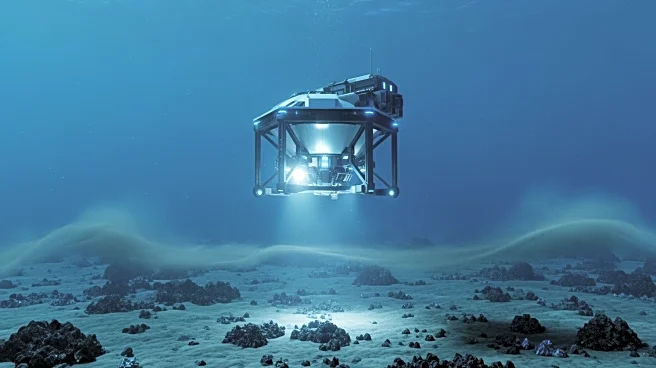
first noted in 2024, suggests that these nodules generate oxygen without sunlight, potentially supporting diverse marine life at great depths. The findings have sparked debate, particularly with deep-sea mining companies that aim to extract valuable metals from these nodules. The research team, led by Andrew Sweetman from the Scottish Association for Marine Science, aims to confirm the existence of dark oxygen and understand its production mechanisms. They hypothesize that the nodules generate an electric current capable of splitting seawater into hydrogen and oxygen. The team plans to deploy instruments to measure oxygen fluxes and analyze microbial activity in the nodules.
Why It's Important?
The discovery of dark oxygen challenges existing assumptions about oxygen production and its role in supporting deep-sea ecosystems. If confirmed, it could have significant implications for environmental policies regarding deep-sea mining. The presence of oxygen-producing nodules might necessitate stricter regulations to protect these ecosystems from mining activities. The findings could also influence the United Nations' decisions on permitting deep-sea mining in international waters. The research highlights the need for a deeper understanding of deep-sea environments before exploiting them for resources, potentially impacting the strategies of mining companies and environmental groups.
What's Next?
The research team plans to conduct further experiments to validate their findings and address criticisms from mining companies. They will use advanced techniques to simulate deep-sea conditions and study the electrochemical processes involved in oxygen production. The results could lead to a reevaluation of deep-sea mining practices and influence international regulatory frameworks. The ongoing debate may also prompt increased scrutiny of environmental impacts associated with deep-sea resource extraction.