







What's Happening?
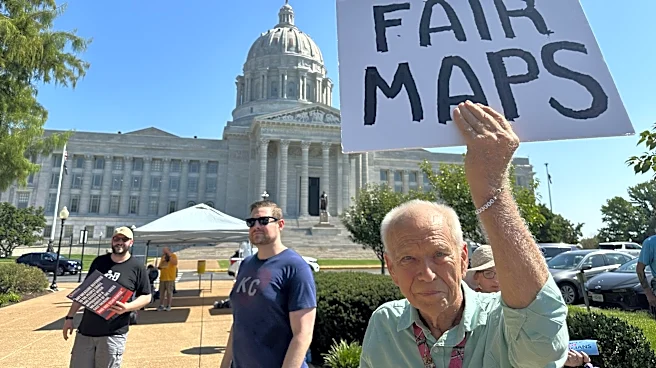
Missouri voters are considering Amendment 6, a ballot measure that could significantly alter the process of congressional redistricting in the state. This amendment, if approved, would require an 80% threshold in both the House and Senate, along with
another statewide vote, before lawmakers could change a congressional map again if voters had previously rejected a similar map through a referendum. This development comes as Republicans in Missouri have expressed intentions to redraw congressional maps, potentially aiming for an '8-0' map (meaning eight Republican-held districts and zero for Democrats) or a '7-1' map. The Missouri Supreme Court recently ruled against a gerrymandered map drawn by Republicans, and the ongoing debate over which map will be used in the upcoming November election highlights the contentious nature of redistricting in the state. The intersection of Amendment 6 and Proposition A, another ballot measure, could make future mid-decade redraws exceptionally difficult.
Why It's Important?
Amendment 6 holds significant implications for the balance of political power and democratic representation in Missouri. By imposing an 80% legislative supermajority and a statewide vote requirement for redrawing maps previously rejected by voters, the amendment aims to prevent lawmakers from overriding the will of the people expressed through referendums. This could empower voters and make it harder for a single party, even with a supermajority, to unilaterally implement highly partisan maps. For instance, Missouri's Republican supermajority, which holds 111 of 163 House seats and 24 of 34 Senate seats, would still need Democratic votes to meet the 80% threshold. This could force greater bipartisan consensus in redistricting, potentially leading to more equitable and less gerrymandered districts. However, opponents argue that such a high threshold could 'cut our legislature off at the knees' and hinder their ability to pass other laws, suggesting a broader impact on legislative functionality beyond just redistricting.
What's Next?
The immediate future hinges on the outcome of the November 3 ballot, where Missouri voters will decide on Amendment 6 and Proposition A. If Amendment 6 passes, any future attempts by the legislature to redraw congressional districts, especially those deemed 'similar in effect' to a map rejected by voters, would face a substantially higher hurdle. This could lead to legal challenges, as the definition of 'similar in effect' is not explicitly defined in the amendment and would likely be interpreted by state courts, including the Missouri Supreme Court. After the 2030 census, the situation becomes even murkier, as new population data would necessitate a new map. While some legal experts believe Amendment 6's 80% requirement might not apply to post-census redistricting due to the federal requirement for equal populations, this remains an unsettled question that would likely be litigated. In the event of a deadlock or a rejected map, Missouri could face the prospect of a court-drawn map for future elections.
Beyond the Headlines
The deeper implications of Amendment 6 extend to the fundamental principles of representative democracy and the role of direct democracy in legislative processes. The amendment represents an attempt to curb partisan gerrymandering, a practice that has been criticized for undermining voter choice and entrenching political power. By making it more difficult for lawmakers to ignore voter referendums, Amendment 6 could strengthen the power of the electorate and foster greater accountability. However, it also raises questions about the potential for legislative paralysis, as requiring an 80% supermajority for certain actions could make it challenging to adapt to changing demographics or political landscapes. The ongoing legal battles and the ambiguity surrounding terms like 'similar in effect' highlight the complex interplay between constitutional amendments, judicial interpretation, and the practical realities of governance. This situation could set a precedent for other states grappling with similar issues of redistricting and voter empowerment.