
What's Happening?
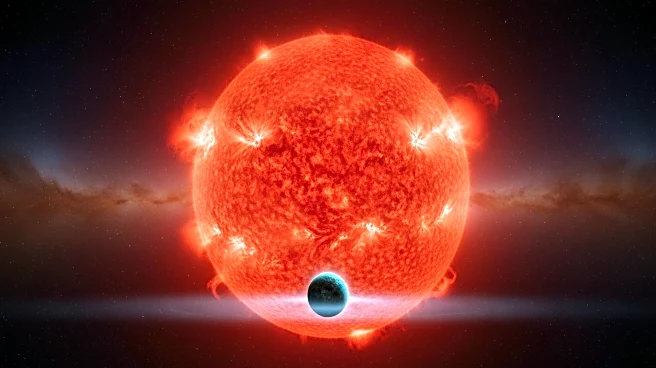
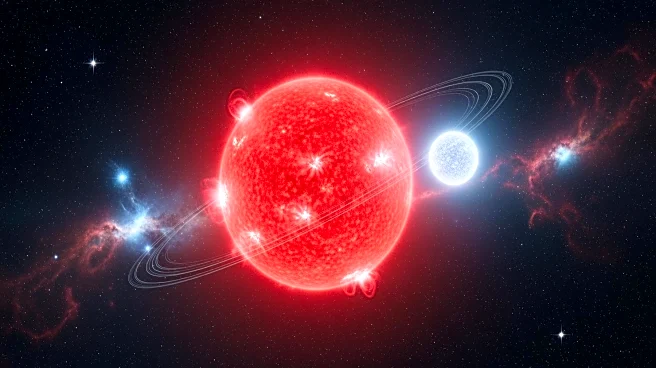
Astronomers using NASA's Hubble Space Telescope, along with ground-based observatories, have discovered a companion star influencing the environment around Betelgeuse. This companion, named Siwarha, is creating
a dense stream of gas as it moves through Betelgeuse's outer atmosphere. The findings, led by researchers at the Center for Astrophysics | Harvard & Smithsonian, were announced at the American Astronomical Society meeting and are set for publication in The Astrophysical Journal. The study utilized nearly eight years of observations to confirm the companion's presence, which had been suspected but not confirmed until now. This discovery helps explain Betelgeuse's unusual brightness changes and atmospheric behavior, providing insights into the evolution of massive stars.
Why It's Important?
The discovery of Siwarha's influence on Betelgeuse is significant for understanding the life cycle of massive stars. Betelgeuse, a red supergiant located about 650 light-years from Earth, is one of the few stars whose surface and atmosphere can be directly studied. Understanding its behavior is crucial for insights into how such stars evolve, lose material, and eventually explode as supernovae. This research not only resolves long-standing mysteries about Betelgeuse's variability but also offers a model for studying other massive stars. The findings could impact astrophysics by providing a clearer picture of stellar evolution and the dynamics of star systems.
What's Next?
Astronomers plan to conduct further observations when Betelgeuse's companion becomes visible again in 2027. These future studies aim to deepen the understanding of the interactions between Betelgeuse and Siwarha, potentially solving similar mysteries in other giant stars. The ongoing contributions of the Hubble Space Telescope, a collaboration between NASA and the European Space Agency, continue to enhance our knowledge of the universe, with mission operations managed by NASA's Goddard Space Flight Center.