



What's Happening?
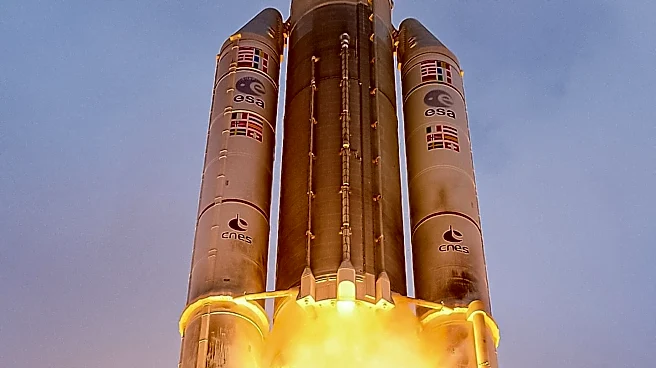
The European Space Agency (ESA) is planning to significantly increase the launch cadence of its Ariane 6 rocket to 12 flights per year by the end of 2029, with a further increase to 15 flights annually beyond 2030. This initiative, as detailed by Géraldine
Naja, Director of Space Transportation at ESA, aims to address a potential shortage of European launchers by 2030 and ensure autonomous access to space for Europe. The plan also includes an increase in Vega-C launches to six, and potentially nine, beyond 2027. This strategic shift comes after a period where Europe faced challenges in independent space access, necessitating reliance on non-European launch providers like SpaceX for institutional satellites. The ESA and ArianeGroup are currently analyzing and developing a new flight and production schedule for Ariane 6 to meet the growing demand, including new contracts with entities like Amazon LEO and Eutelsat.
Why It's Important?
This planned increase in Ariane 6 launches is crucial for bolstering European autonomy in space, reducing reliance on external launch services, and ensuring the deployment of critical European institutional satellites. The move directly impacts the U.S. space industry by potentially decreasing the demand for U.S.-based launch providers for European payloads, thereby intensifying competition in the global launch market. For U.S. companies like SpaceX, which have previously filled gaps in European launch capabilities, this development signifies a strategic reassertion by Europe of its independent space access. The increased cadence also reflects a broader global trend of expanding space activities, including the deployment of large satellite constellations, which will drive innovation and competition in launch vehicle technology and services worldwide. This could lead to more competitive pricing and advanced capabilities across the industry, benefiting both government and commercial space endeavors.
What's Next?
The ESA and its partners, including Arianespace and ArianeGroup, will continue to refine the new flight and production schedules for Ariane 6 and Vega-C. The initial phase of increasing Ariane 6 launches to 12 per year by late 2029 is expected to require limited new investments, primarily through reorienting existing funds and optimizing current resources. However, achieving the target of 15 launches annually will necessitate significant investments, particularly in the productive facilities at the Guiana Space Centre (CSG). A key challenge identified is the production of boosters, with an anticipated need for 50 P120C boosters by 2030 for both Ariane 6 and Vega-C. ESA is actively working with Europropulsion, ArianeGroup, and Avio to address this potential bottleneck and ensure the necessary production increase. The long-term goal is to achieve a launch capacity at CSG that could approach 30 launches per year by 2030, encompassing Ariane 6, Vega-C, and mini-launchers.
Beyond the Headlines
The drive to increase Ariane 6's launch cadence extends beyond mere logistical adjustments; it represents a fundamental shift in Europe's strategic approach to space. The emphasis on sovereign launchers for sovereign satellites underscores a geopolitical imperative to maintain independent access to space for defense, scientific research, and economic development. This move could trigger a ripple effect, encouraging other nations or blocs to similarly invest in their indigenous launch capabilities, potentially leading to a more fragmented but also more resilient global space infrastructure. Furthermore, the challenge of scaling booster production highlights the intricate supply chain dependencies within the space industry. Overcoming such hurdles will not only ensure Europe's space autonomy but also foster advancements in manufacturing processes and materials science, with potential spillover benefits for other high-tech sectors. The long-term vision of a diverse European launcher family, including heavy, medium, and mini-launchers, aims to provide flexibility and cost-effectiveness for various mission profiles, from deploying large constellations to scientific probes.