


What's Happening?
Texas Republicans are escalating their campaign against what they term 'sharia law,' characterizing it as a threat to democracy, religious freedom, and American values. This stance is reflected in the Republican Party of Texas platform, which includes
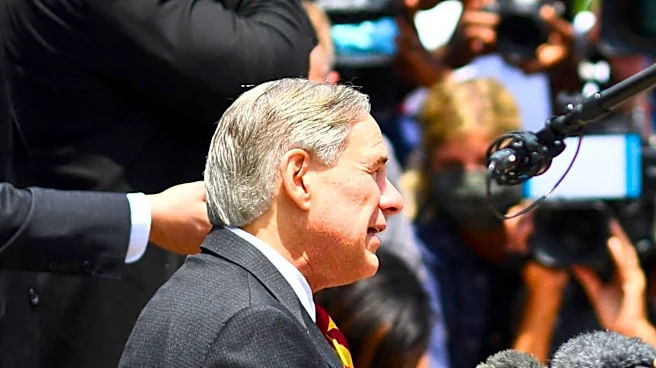
a resolution titled 'Don’t Sharia My Texas.' This resolution calls for legislative and constitutional amendments to declare sharia law seditious, make its advocacy a crime disqualifying individuals from public service, and request the federal government to deport or denaturalize its advocates. State Rep. Brent Money established the Sharia Free Texas Caucus in the state Legislature, following the creation of the Sharia-Free America Caucus in Congress by U.S. Reps. Keith Self and Chip Roy. Governor Greg Abbott has also taken action, threatening to withhold funding from airports over Muslim prayer washing stations and labeling the Council on American-Islamic Relations (CAIR) a terrorist organization. In response, the Muslim community in Texas is pushing back, asserting that the term 'sharia' is being distorted by ignorance and political opportunism. They define sharia as a personal ethical and moral framework for practicing faith, not a legal system intended to supersede U.S. law.
Why It's Important?
This intensified focus on sharia law by Texas Republicans carries significant implications for religious freedom, civil liberties, and interfaith relations in the United States. The legislative proposals, such as criminalizing the advocacy of sharia law and potentially deporting its proponents, raise serious constitutional questions regarding the First Amendment's protection of religious expression. The actions by Governor Abbott and the formation of 'Sharia Free' caucuses contribute to a climate of fear and misunderstanding around Islam, potentially alienating a significant portion of the American Muslim population. This political rhetoric could also embolden discriminatory practices and policies against Muslims, impacting their ability to participate fully in public life and practice their faith without undue scrutiny. The debate highlights a fundamental clash between a perceived threat to American legal principles and the religious practices of a minority group, underscoring the ongoing challenges of religious pluralism in a diverse society.
What's Next?
The Texas Legislature, convening in January, is expected to consider proposals stemming from the Republican Party of Texas platform regarding sharia law. These could include legislation to restrict Islamic dress, close Islamic charter schools, and withhold professional licenses from Muslims. The Sharia Free Texas Caucus will likely champion these efforts. Meanwhile, Muslim civil rights organizations, such as CAIR Texas, and community leaders will continue their efforts to educate the public and lawmakers on the true meaning of sharia as a personal moral code, not a competing legal system. They will likely engage in advocacy, public awareness campaigns, and potentially legal challenges to counter what they view as Islamophobic policies. The ongoing political discourse and legislative actions in Texas could set precedents or influence similar debates in other states, further shaping the national conversation on religious freedom and the integration of diverse communities.
Beyond the Headlines
The controversy surrounding sharia law in Texas delves into deeper societal anxieties about cultural identity, national security, and the interpretation of religious texts in a secular legal framework. The Republican narrative often frames sharia as a monolithic, oppressive legal system, contrasting sharply with the nuanced understanding presented by Islamic scholars and practitioners who view it as a diverse set of ethical guidelines. This disconnect highlights a broader challenge in American society: how to reconcile differing cultural and religious understandings within a shared civic space. The use of terms like 'seditious' and 'subversive' to describe a religious concept can have profound psychological and social impacts, fostering distrust and division. This situation also echoes historical patterns of fear-mongering against minority religious groups, such as Catholics in the 19th century, suggesting a recurring tension in American history regarding religious pluralism and national identity. The outcome of this debate in Texas could influence how religious diversity is understood and accommodated in the U.S. for years to come.