






What's Happening?
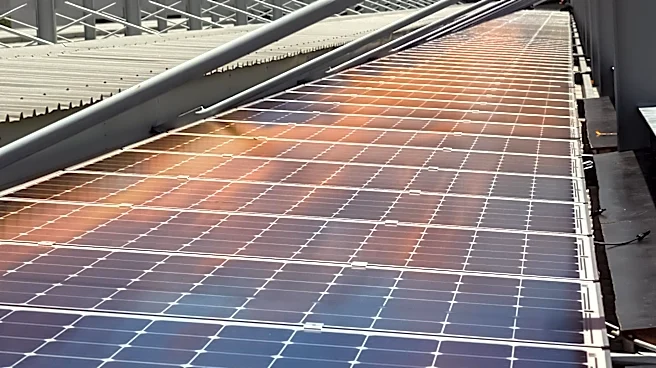
A new analysis by Environment North Carolina Research & Policy Center and Frontier Group reveals that North Carolina's public school rooftops could generate enough solar energy to power nearly 150,000 homes annually. The report estimates that approximately
2,400 public schools, representing about 90% of those analyzed, possess suitable rooftop space for solar panels. If fully developed, this potential could support over 900 megawatts of solar capacity and produce around 1.6 terawatt-hours of electricity in the first year, accounting for about 1.2% of North Carolina's current annual electricity consumption. Wake County leads the state with an estimated 75 megawatts of potential rooftop solar capacity, followed by Mecklenburg County (71 megawatts) and Guilford County (41 megawatts). Durham County schools could support about 24 megawatts. The study utilized federal data, satellite imagery, and solar modeling tools, considering factors like rooftop obstructions and condition.
Why It's Important?
Tapping into the solar potential of North Carolina's school rooftops offers significant environmental and economic benefits. Environmentally, fully developing this capacity could avoid approximately 1.3 million tons of carbon dioxide emissions annually, along with reductions in nitrogen oxides and fine-particle pollution, contributing to cleaner air and combating climate change. Economically, while upfront costs and roof upgrades are barriers, rising electricity prices could make solar more financially attractive over time. The report highlights a critical policy barrier: North Carolina does not permit third-party power purchase agreements (PPAs), a common financing tool elsewhere that allows private companies to install and maintain solar systems, selling electricity back to schools and eliminating much of the upfront cost for districts. Overcoming this legislative hurdle could unlock substantial investment and savings for schools, freeing up funds for educational priorities and reducing operational expenses.
What's Next?
The report recommends several policy changes to unlock North Carolina's school rooftop solar potential. These include establishing a solar schools grant program, allowing third-party power purchase agreements (PPAs), and examining utility rate structures and interconnection policies that currently hinder the economic viability of school solar projects. Additionally, the report suggests increased funding to help schools repair or replace roofs and make necessary electrical upgrades for solar installations. These recommendations come at a time when North Carolina's electricity demands are growing and utility rates are increasing, placing greater emphasis on sustainable energy solutions. The implementation of these policy changes would be crucial for schools to leverage their rooftops for solar power, potentially leading to widespread adoption and significant contributions to the state's energy portfolio.
Beyond the Headlines
The untapped solar potential on North Carolina's school rooftops represents more than just an energy opportunity; it's a chance to integrate sustainability into the educational landscape and foster community resilience. Beyond generating electricity, solar installations, especially when paired with battery storage, can transform schools into critical community hubs during emergencies like hurricanes, providing power for shelters. This dual function enhances public safety and community preparedness. Furthermore, these projects can serve as living laboratories for students, offering hands-on learning experiences in renewable energy and environmental science, thereby inspiring the next generation of innovators. The policy barriers, particularly the prohibition of third-party PPAs, underscore a broader challenge in transitioning to clean energy: regulatory frameworks often lag behind technological advancements and economic opportunities. Addressing these legislative issues could set a precedent for other states, demonstrating how public institutions can lead the way in sustainable development while simultaneously benefiting their communities and educational missions.