



What's Happening?
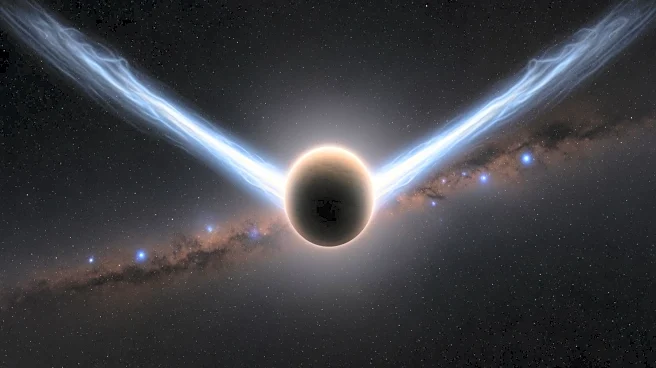
The James Webb Space Telescope (JWST) has made a groundbreaking discovery of an exoplanet, WASP-121b, exhibiting two extensive helium gas tails. This ultrahot Jupiter, located approximately 858 light-years away, orbits its star every 30 hours, with its atmosphere
reaching temperatures of around 4,200 degrees Fahrenheit. The helium tails are 100 times longer than the planet's width and extend three times the distance between the planet and its star. This phenomenon challenges existing scientific models, as such dual tails have not been observed before. The discovery was made using JWST's Near-Infrared Spectrograph (NIRSpec) over a continuous 37-hour observation period.
Why It's Important?
This discovery is significant as it provides new insights into atmospheric escape processes on exoplanets, particularly those classified as ultrahot Jupiters. Understanding these processes is crucial for comprehending how planets evolve over time, especially in extreme environments. The findings challenge current models of atmospheric dynamics and could lead to the development of new theories about planetary atmospheres and their interactions with stellar radiation. This research enhances our understanding of exoplanetary systems and their potential for hosting life, as well as the broader mechanisms of planetary formation and evolution.
What's Next?
The scientific community is expected to delve deeper into the implications of this discovery, potentially revising existing models of atmospheric escape. Further observations and studies will likely focus on understanding the physical mechanisms behind the formation of such extensive gas tails. Researchers may also explore the possibility of similar phenomena occurring on other exoplanets, which could provide a broader understanding of atmospheric dynamics in extreme conditions. The JWST will continue to play a pivotal role in these investigations, offering unprecedented observational capabilities.