
What's Happening?
A new theoretical paper suggests that the masses of fundamental particles, such as the Z and W bosons, may arise from the twisted geometry of hidden dimensions rather than the Higgs field. This research,
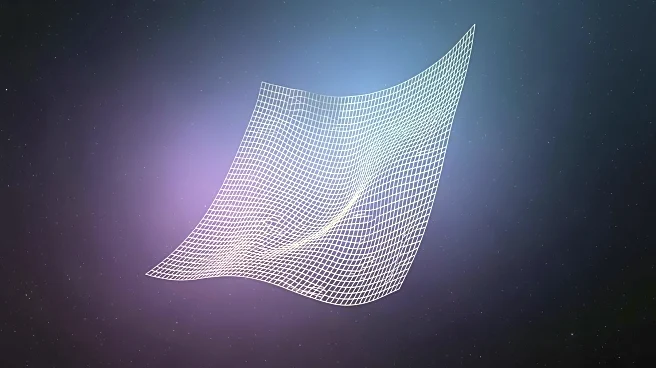
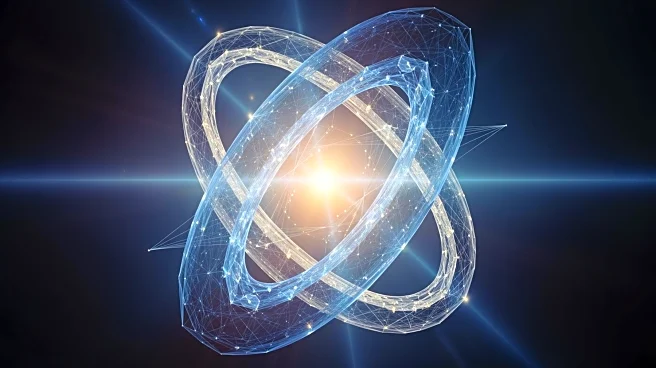
led by theoretical physicist Richard Pinčák of the Slovak Academy of Sciences, proposes that matter emerges from the resistance of geometry itself. The study explores a seven-dimensional space known as a G2 manifold, which could provide a purely geometric explanation for phenomena like spontaneous symmetry breaking. The researchers developed a new equation, the G2-Ricci flow, to model how a G2 manifold changes over time, finding that it can settle into stable configurations called solitons. These solitons could produce the same mass-giving effect as the Higgs mechanism.
Why It's Important?
This research challenges the traditional understanding of particle mass, which has been largely attributed to the Higgs field since its proposal in the 1960s. The Higgs field's discovery was pivotal in building the Standard Model of particle physics. However, it does not explain all aspects of the universe, such as dark matter and dark energy. The new theory suggests that the geometry of hidden dimensions could be responsible for particle mass, offering a potential solution to some of the gaps in the Standard Model. If proven, this could revolutionize our understanding of fundamental physics and lead to new discoveries in particle physics.
What's Next?
The researchers have named a hypothetical particle, the Torstone, which could be detectable in particle collider anomalies or cosmic microwave background glitches. If the torsion field exists, it could manifest particles similar to how the Higgs field gives rise to the Higgs boson. Future experiments in particle colliders and observations of cosmic phenomena may provide evidence for this theory. The scientific community will likely continue to explore the implications of this research, potentially leading to new insights into the fundamental nature of the universe.