






What's Happening?
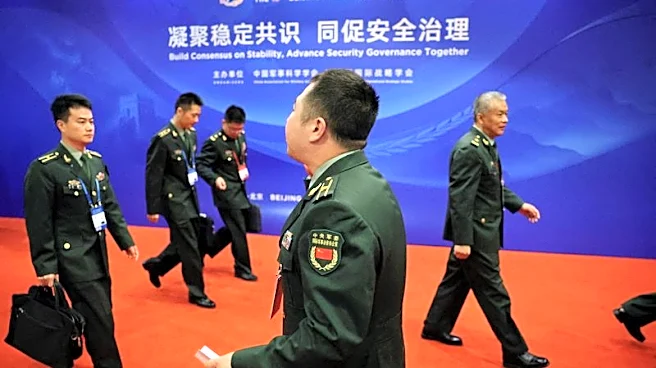
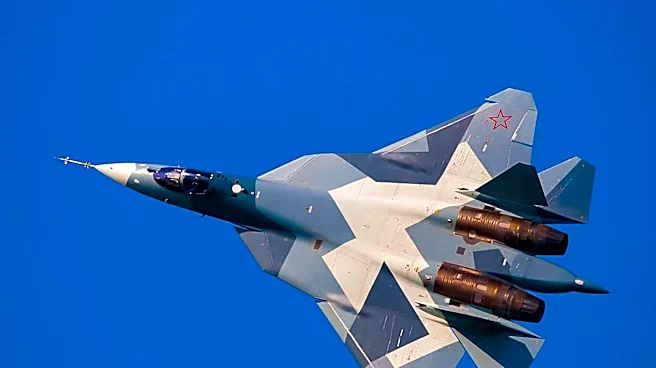
China is investigating the integration of laser weapons into its sixth-generation fighter jets, potentially enabling them to defend against incoming missiles. This development was hinted at during the 14th China International Defence Electronics Exhibition
in Beijing, held from September 15 to 17. The Aviation Industry Corporation of China (AVIC) Beijing Precision Engineering Institute for Aircraft Industry showcased details of a 'fighter aircraft laser-weapon tracking and aiming system.' According to social media posts, the display indicated that the system weighs less than 380kg (838lbs). While some key performance figures, such as transmission power and dynamic tracking accuracy, were partially obscured or redacted, the listed transmission power of '*00kW' suggests a capability of at least 100kW. This public display offers the strongest indication yet of China's progress in developing airborne laser systems for advanced fighter aircraft.
Why It's Important?
The potential deployment of laser weapons on China's sixth-generation fighter jets represents a significant leap in military aviation technology and could have profound implications for aerial combat and defense strategies. Laser weapons offer several advantages, including high-speed engagement, precision targeting, and potentially unlimited ammunition, which could revolutionize how fighter jets defend against missile threats. For the U.S. and its allies, this development underscores the accelerating pace of military technological advancement by China, necessitating continuous innovation and adaptation in their own defense programs. If successful, these laser systems could enhance the survivability of Chinese fighter jets, making them more formidable adversaries in potential conflicts. This could also trigger a new arms race in directed energy weapons, compelling other major military powers to invest heavily in similar technologies to maintain a strategic balance. The ability to counter incoming missiles with lasers could fundamentally alter air-to-air combat doctrines and the effectiveness of current missile systems.
What's Next?
Further development and testing of the 'fighter aircraft laser-weapon tracking and aiming system' are expected as China continues its pursuit of sixth-generation fighter jet capabilities. The Aviation Industry Corporation of China (AVIC) and its associated institutes will likely focus on refining the system's power, accuracy, and weight to ensure its viability for airborne integration. Future exhibitions and military publications may reveal more specific details about the system's performance and operational readiness. The successful integration of such advanced weaponry could lead to its eventual deployment on China's next-generation aircraft, potentially altering the balance of power in aerial warfare. Other global military powers will closely monitor China's progress, likely accelerating their own research and development efforts in directed energy weapons to counter this emerging threat and maintain technological parity.
Beyond the Headlines
The development of airborne laser weapons by China raises several deeper implications. Ethically, the deployment of such advanced and potentially devastating weapons systems could escalate the nature of warfare, making conflicts more destructive and unpredictable. The precision and speed of lasers could lead to a re-evaluation of international arms control treaties and the laws of armed conflict. Legally, the classification and regulation of directed energy weapons are still evolving, posing challenges for international governance. Culturally, the pursuit of such cutting-edge military technology reflects China's ambition to become a global leader in defense innovation, projecting an image of technological prowess and military strength. This technological race could also have significant economic consequences, diverting substantial resources towards military research and development. The long-term shift towards directed energy weapons could render conventional missile defense systems obsolete, forcing a fundamental rethinking of national security strategies worldwide and potentially leading to a new era of military competition focused on energy-based weaponry.