
What's Happening?
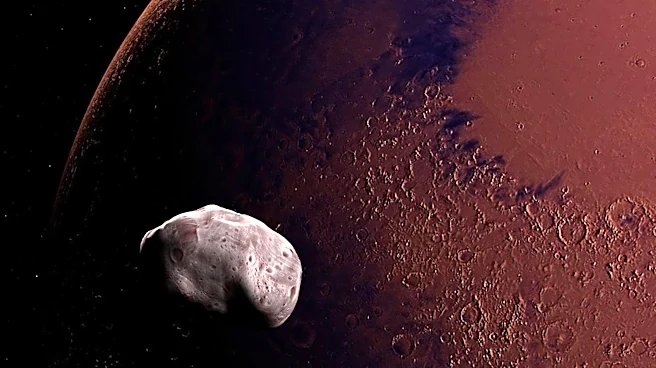
A new study, informed by flyby images from the European Space Agency’s (ESA) Hera asteroid mission, suggests that Mars’s smaller outer moon, Deimos, was significantly reshaped by a single, violent asteroid impact.
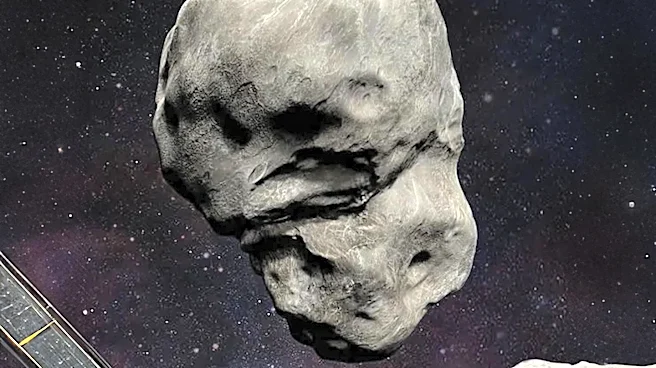
This impact is believed to be responsible for Deimos's unusually smooth and youthful appearance, as a thick layer of dust from the collision may have acted as a 'cosmetic filler' for the moon. Deimos, which is potato-shaped and approximately 12 km in diameter, orbits Mars at about 24,000 km. Early observations by NASA’s 1970s Viking orbiters noted its smoother and dustier surface compared to the heavily cratered Phobos, Mars's other moon. The study, led by Sabina Raducan of the University of Bern, utilized a High Performance Computing Cluster to run a Bern Smoothed Particle Hydrodynamics (SPH) impact code. This code recreated Deimos as millions of adhering particles, allowing for simulations of various impactor masses and angles. The most fitting simulation indicated a slanting, 45-degree impact from a relatively small 320-meter-wide asteroid, striking Deimos at high speed. This collision excavated a large depression at the moon's south pole and scattered significant amounts of material across its surface.
Why It's Important?
This research offers a unified explanation for Deimos's distinctive smooth surface and its prominent southern depression, providing valuable insights into the formation and evolution of planetary moons. The finding that much of the debris from the impact later fell back to form a global blanket of loose regolith, covering existing surface features to depths exceeding two hundred meters, helps explain the moon's 'youthful' appearance. The study also suggests that Deimos has a relatively fragile, highly porous, and fractured interior, akin to a 'rubble-pile body' similar to many asteroids. This characteristic allowed the moon to dampen impact forces efficiently, preserving older, buried craters beneath the dust layer. This understanding is crucial for planetary science, as it sheds light on the internal structure of celestial bodies and how they respond to cosmic impacts. The methodology, which involved extensive simulations and was refined by Hera's observations, demonstrates advanced techniques in astrophysical research and planetary defense, enhancing our ability to predict and understand the consequences of asteroid impacts.
What's Next?
The findings of this study will be further tested and validated by future space missions. The Japan Aerospace Exploration Agency’s (JAXA) Martian Moons eXploration (MMX) mission, scheduled to launch this autumn, will visit both Martian moons and is expected to provide additional data to confirm or refine these predictions. ESA’s Hera mission itself will continue its work, reaching Dimorphos this autumn to conduct a close-up investigation of the crash site from NASA’s DART mission. This will further boost humankind’s planetary defense capabilities by providing real-world data on asteroid impact effects. The SPH code used in this Deimos study was previously employed to simulate the DART impact on Dimorphos, and its accuracy will be verified by Hera's observations. The ongoing research and upcoming missions will continue to deepen our understanding of asteroid impacts, moon geology, and the broader dynamics of our solar system, with implications for future space exploration and planetary protection strategies.
Beyond the Headlines
The study's revelation that Deimos's interior is likely a 'rubble-pile body' has profound implications for our understanding of moon formation. While it doesn't definitively classify Deimos as a captured asteroid, it suggests that its formation process might share similarities with asteroids, leading to comparable properties. This challenges traditional views of moon formation and highlights the complex interplay of gravitational forces and cosmic collisions in shaping celestial bodies. The preservation of pre-impact craters beneath the regolith layer, despite a violent impact, underscores the unique material properties of Deimos and offers a natural laboratory for studying impact mechanics on porous bodies. Furthermore, the collaborative effort between scientific teams and the use of advanced computational modeling, guided by real-world mission data from Hera, exemplifies the cutting edge of space research. The involvement of individuals like Sir Brian May in analyzing spectroscopic depictions of Hera images also showcases the diverse expertise contributing to space science, bridging scientific rigor with broader public engagement in astronomical discoveries.