







What's Happening?
An international team of researchers has experimentally demonstrated a fundamental limit to the precision with which an electron’s position and the time of its motion can be simultaneously determined. This work, involving groups from the Regensburg Center
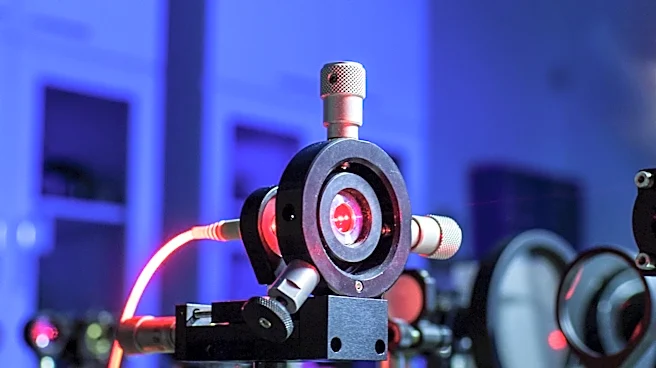
for Ultrafast Nanoscopy and the Max Planck Institute, utilized a laser system with high temporal resolution. In the experiment, electrons were directed from an ultrasharp metal tip to a silver surface, with their motion recorded through electric current and transfer time measured using two light pulses. The electrons exhibited quantum tunneling, behaving as quantum waves, with motion observed on attosecond timescales. Quantum simulations confirmed the experimental results, showing electrons responded to the light field with a delay of approximately 500 attoseconds. The study also revealed that increased precision in determining an electron's motion time requires more energy, causing the electron's wave packet to stretch spatially.
Why It's Important?
This research is significant for the U.S. technology sector as it provides a foundational understanding of electron behavior at its most fundamental limits, which is crucial for developing next-generation electronic devices and quantum information processing systems. The ability to control electron wave packets could lead to advancements in initiating chemical reactions and observing changes in chemical bonds, impacting industries from pharmaceuticals to materials science. The potential to create electronics hundreds of thousands of times faster than current CMOS technology, while a long-term goal, highlights the transformative impact this research could have on computing power and efficiency. U.S. companies and research institutions investing in quantum computing and advanced electronics stand to benefit from these insights, potentially leading to new patents and market leadership.
What's Next?
The researchers envision that controlled electron wave packets could eventually be used to initiate chemical reactions and observe changes in chemical bonds. They also see these findings as a basis for future electronic devices and quantum information-processing systems that will operate closer to the fundamental speed limit of electron motion. While the creation of electronics significantly faster than current CMOS technology is a long-term objective, this research lays the groundwork for such advancements. The U.S. scientific community will likely continue to explore these fundamental limits, aiming to translate theoretical understanding into practical applications that could redefine the capabilities of electronic and quantum technologies.
Beyond the Headlines
This discovery delves into the very fabric of quantum mechanics, challenging and refining our understanding of the universe's most basic principles. The concept of a fundamental space-time limit for electrons has profound implications beyond just technology, touching upon philosophical questions about the nature of reality and measurement. Ethically, as technology approaches these fundamental limits, discussions around the responsible development and deployment of ultra-fast computing and quantum technologies will become increasingly important. The research also highlights the collaborative nature of modern science, with international teams pushing the boundaries of knowledge, which can foster global scientific cooperation and shared progress.