






What's Happening?
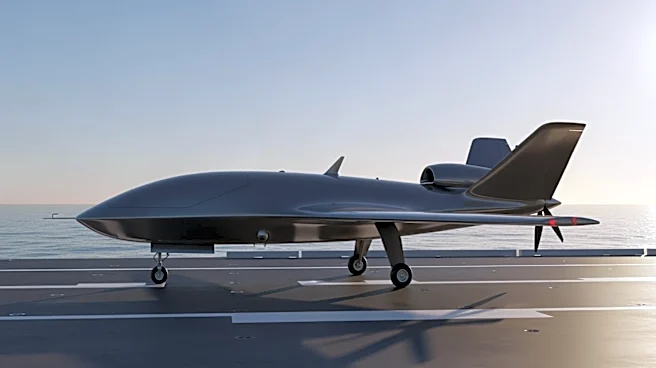
The U.S. Navy has approved the MQ-25A Stingray for low-rate initial production and deployment, as announced by Acting Secretary of the Navy, Hung Cao, during a Senate Armed Services Committee Hearing. The MQ-25A, developed by Boeing, is the first operational
carrier-based unmanned aircraft designed to relieve the Navy’s F/A-18 Super Hornets of their aerial refueling duties. This transition marks a significant milestone in the defense acquisition process, allowing the program to move from the Engineering and Manufacturing Development phase into production and deployment. The MQ-25A's development has been ongoing since a $805 million contract was signed in 2018, with the Navy planning to acquire 72 aircraft at an estimated cost of $13 billion.
Why It's Important?
The deployment of the MQ-25A Stingray is a strategic enhancement for the U.S. Navy, as it extends the operational reach of Carrier Strike Groups by integrating unmanned refueling capabilities. This development is expected to improve the readiness and service life of the F/A-18E/F Super Hornets by allowing them to focus on strike missions rather than refueling tasks. The introduction of the MQ-25A also represents a significant advancement in military technology, showcasing the increasing role of unmanned systems in modern warfare. This shift could influence future defense strategies and procurement decisions, potentially leading to further investments in unmanned aerial systems.
What's Next?
The Navy plans to award a low-rate initial production contract for three MQ-25A aircraft this summer, with options for additional aircraft in subsequent lots. As the MQ-25A becomes operational, it will be integrated into the carrier air wing, enhancing the Navy's capabilities. The successful deployment of the MQ-25A could prompt further developments in unmanned systems, potentially leading to new roles and missions for such technologies within the military. Stakeholders, including defense contractors and military strategists, will likely monitor the program's progress closely to assess its impact on future defense initiatives.