




What's Happening?
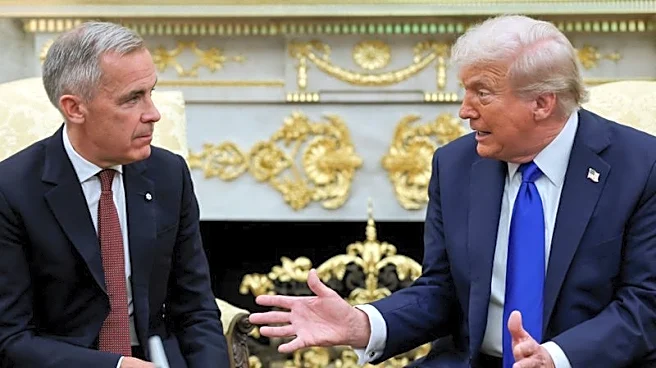
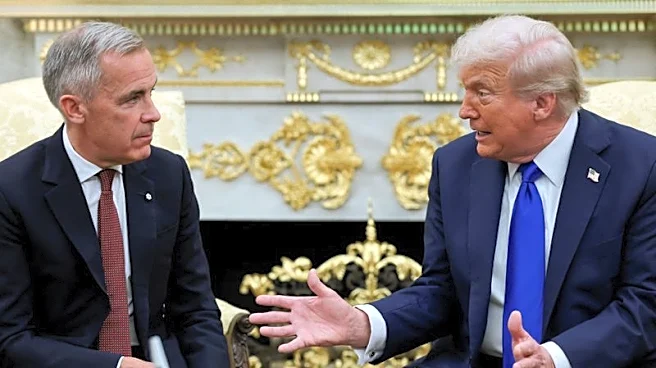
U.S. Vice President JD Vance recently commented on the latest trade deal with Canada at a fundraising event in Southampton, N.Y. Vance stated that Canadian Prime Minister Mark Carney attempted to 'out-tough' President Trump during negotiations. While
acknowledging a good personal relationship with Carney, Vance characterized Carney's approach as 'puffs his chest out and says, 'I'm going to, like, out-tough Donald Trump.'' Vance also credited his long-time friend, Conservative MP Jamil Jivani, as a helpful advocate for Canada in these discussions. He suggested that Canada 'climb down on a lot of issues' despite Carney presenting the deal as a victory. Vance indicated that President Trump was not willing to 'bend over to make Canada happy' but saw an opportunity for wins for the U.S., aiming to 'change Canada’s behaviour' towards a 'Trumpian direction.' The comments were made as a new round of tariffs on Canadian products loomed, with a last-minute deal delaying them for three days following a call between President Trump and Prime Minister Carney.
Why It's Important?
Vice President Vance's remarks offer insight into the U.S. administration's perspective on trade negotiations with Canada, highlighting a perceived power dynamic where Canada ultimately conceded on several issues. This narrative could influence future trade discussions and the broader U.S.-Canada relationship, potentially emboldening the U.S. to adopt similar assertive stances in other bilateral trade agreements. The acknowledgment of Conservative MP Jamil Jivani's role as an 'effective advocate' for Canada, despite his party's leader, Pierre Poilievre, being described as a 'non-entity' in negotiations, suggests a complex and potentially fractured Canadian political landscape regarding U.S. relations. This could lead to internal political challenges within Canada and impact how future Canadian governments approach trade diplomacy with the U.S. The U.S. administration's goal to 'change Canada’s behaviour' towards a 'Trumpian direction' signifies a desire for ideological alignment in trade and economic policies, which could have long-term implications for North American economic integration and sovereignty.
What's Next?
The immediate future will likely involve continued scrutiny of the recently concluded trade deal between the U.S. and Canada, particularly regarding the specific concessions made by Canada. The U.S. administration's public stance on the negotiations could influence how the deal is perceived and implemented by both countries. The role of individuals like Jamil Jivani in informal diplomatic channels may continue to be a factor, potentially creating alternative avenues for communication and negotiation outside traditional government structures. This could lead to further internal debate within Canadian political parties regarding their approach to U.S. relations. The broader objective of shifting Canada's behavior towards a 'Trumpian direction' suggests that the U.S. will continue to exert pressure on Canada to align its policies with U.S. interests, particularly in areas such as trade and economic regulation. This ongoing dynamic will shape the future of North American economic and political relations.
Beyond the Headlines
The Vice President's comments reveal a deeper layer of personal relationships and informal diplomacy influencing international trade negotiations. The emphasis on Jamil Jivani's role, a personal friend of Vance, suggests that personal connections can sometimes bypass or supplement formal diplomatic channels, potentially leading to outcomes that might not otherwise be achieved. This raises questions about the transparency and accountability of such informal influences in high-stakes international agreements. Furthermore, the characterization of Prime Minister Carney's negotiating style and the assertion that Canada 'climb down' on issues could be seen as a strategic move to shape public perception and reinforce the U.S. administration's image as a tough negotiator. This narrative could have lasting psychological effects on future negotiations, potentially making it more challenging for smaller nations to assert their interests against a more dominant power. The desire to shift another nation's 'behaviour' towards a specific ideological direction also touches upon the broader theme of national sovereignty and the pressures faced by countries in maintaining their distinct political and economic identities in a globalized world.