



What's Happening?
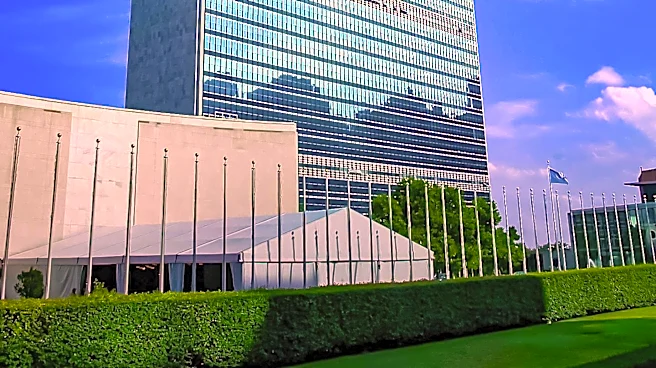
France has gathered members of the United Nations Security Council, along with experts, to discuss the potential use of artificial intelligence (AI) in conflict resolution. This initiative, led by France's permanent representative to the UN, Jérôme Bonnafont,
aims to explore how AI can contribute to the Council's primary responsibility of maintaining international peace and security. The closed informal session, held in New York City, focused specifically on AI's application in early-warning systems and conflict management. This discussion comes amidst deepening political divisions and distrust among Council members, which have frequently stalled decisive action on various global issues. While members acknowledge both the potential and risks of AI, there is disagreement on how to address these risks, with Russia questioning the Council's suitability for developing AI guidelines, suggesting universal UN forums like the General Assembly are more appropriate.
Why It's Important?
The Security Council's engagement with AI signifies a critical juncture in international diplomacy, acknowledging the transformative potential of technology in global governance. The debate over AI's role in conflict resolution highlights the urgent need for international frameworks and ethical guidelines for its deployment. The existing political divisions within the Council, particularly between Western nations, China, and Russia, underscore the challenges in achieving consensus on AI governance. The discussion also brings to light the widening technological gap between the Global North and South, raising concerns about equitable access and control over AI. How the Council navigates these complexities will set precedents for future international cooperation on emerging technologies and could significantly impact global security and stability.
What's Next?
The discussions within the Security Council are expected to continue, with France and its co-organizers (Bahrain, Greece, and Latvia) strategically framing the conversation around AI's impact on existing Council mandates like peace operations and conflict prevention. This approach aims to bypass broader, more divisive debates on global AI governance. However, competition between the U.S. and China over AI standards will likely make reaching a comprehensive agreement difficult. Experts suggest starting with modest steps, such as a limited Security Council resolution recognizing the issue, before attempting to establish minimum standards over time. The politicization of data, particularly in early-warning systems and peacekeeping operations, is also anticipated to become a contentious issue, mirroring past disagreements over cyberattacks and data ownership. The ongoing debate will determine whether AI can bridge political divides or if existing mistrust will simply extend into the AI age.
Beyond the Headlines
The Security Council's foray into artificial intelligence for conflict resolution carries profound implications beyond immediate policy discussions. It signals a recognition that AI is not merely a technological tool but a force capable of reshaping geopolitical power dynamics and the very nature of warfare and peace. The debate over who controls AI, and whose ethical frameworks will prevail, touches upon fundamental questions of sovereignty, human rights, and global equity. The potential for AI to process vast amounts of data for early-warning systems, while promising, also raises concerns about surveillance, bias in algorithms, and the weaponization of information. This could lead to a new form of 'data colonialism' where technologically advanced nations exert undue influence. The struggle to establish international norms for AI reflects a deeper ideological battle over the future of global governance, where the promise of technological advancement is intertwined with the peril of exacerbating existing inequalities and conflicts.