





What's Happening?
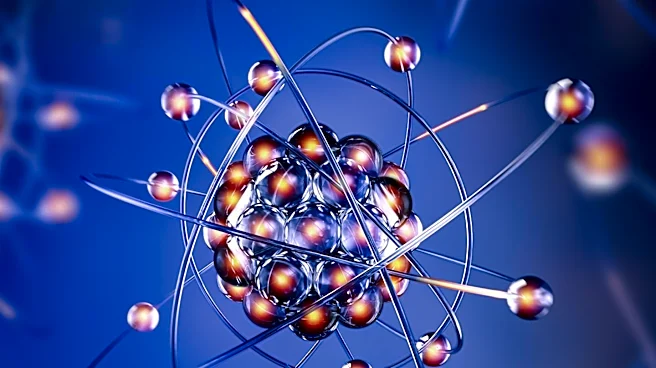
Researchers at ETH Zurich and the Paul Scherrer Institute (PSI) have developed a new method to create a controlled beam of muonium, an exotic atom composed of a positively charged antimuon and a negatively charged electron. This breakthrough allows scientists
to test, for the first time, whether gravity acts on second-generation particles in the same way it does on ordinary matter, as predicted by Albert Einstein's theory of gravity. The familiar matter that constitutes people and planets belongs to the first generation of particles, while muons are heavier relatives of electrons, classified as second-generation particles. The experiment aims to measure how muonium behaves under gravity, which would be the first such test involving a second-generation particle. A key challenge has been the short lifespan of muons (approximately 2.2 microseconds) and the difficulty in producing muonium atoms that travel at consistent speeds and directions suitable for precise measurements. The new method involves directing antimuons into superfluid helium cooled close to absolute zero, which helps produce 'cold' muonium atoms that propagate at similar speeds and almost parallel to one another, making the gravity experiment feasible.
Why It's Important?
This research is significant because it directly challenges a fundamental assumption of modern physics: that gravity affects all particles equally, regardless of their generation. Einstein's equivalence principle, which connects gravitational mass with inertial mass, has been demonstrated for ordinary matter and first-generation antimatter, but never for second-generation particles like muonium. Any deviation from Einstein's predictions in this experiment could have profound implications, potentially pointing towards new physics beyond the Standard Model, including the existence of a hypothetical fifth force. The Standard Model of particle physics describes different generations of particles but does not explain why these additional generations exist or why there are three in total. Testing muonium's gravitational behavior could provide crucial insights into these mysteries, advancing our understanding of the universe's fundamental forces and particle interactions. The ability to create a controlled beam of muonium also opens doors for more precise laser spectroscopy experiments, which could refine our understanding of the muon's mass and fundamental physical constants.
What's Next?
The researchers are currently constructing an interferometer, an instrument designed to measure how Earth's gravity affects the muonium beam. This device will utilize the wave properties of atoms to produce an interference pattern, and any shift in this pattern caused by gravity will allow scientists to determine gravity's effect on the muon. The team anticipates testing this method with the atomic beam within the current year, with the full gravity experiment expected to commence in the next two to three years. If the experiment reveals that muonium responds to gravity differently from ordinary matter, it would be a surprising and significant discovery, potentially leading to a re-evaluation of current physical theories. While discovering a fifth force is not the primary objective, such a finding would be a major consequence. The immediate goal remains to determine if the equivalence between gravitational and inertial mass applies to second-generation particles, a fundamental question that could reshape our understanding of physics.
Beyond the Headlines
The deeper implications of this research extend to the very fabric of our understanding of the universe. If gravity does not act uniformly across all generations of particles, it would necessitate a significant revision of the Standard Model and potentially Einstein's theory of general relativity. This could lead to a paradigm shift in physics, similar to the advent of quantum mechanics. The concept of a 'fifth force' has been a long-standing theoretical possibility, and experimental evidence from muonium could provide the first tangible clue to its existence. Such a discovery would not only expand our knowledge of fundamental forces but also open new avenues for exploring dark matter and dark energy, which are currently unexplained by existing theories. Furthermore, the development of techniques to manipulate exotic atoms like muonium with such precision highlights the continuous advancement in experimental physics, pushing the boundaries of what can be observed and measured at the quantum level. This research embodies the scientific pursuit of fundamental truths, where even a small deviation from expected results can unlock entirely new realms of discovery.