
What's Happening?
Recent research has uncovered that a fragile clay layer beneath the Japan Trench played a significant role in the extreme seafloor movement during the 2011 Tōhoku earthquake. This discovery was made through
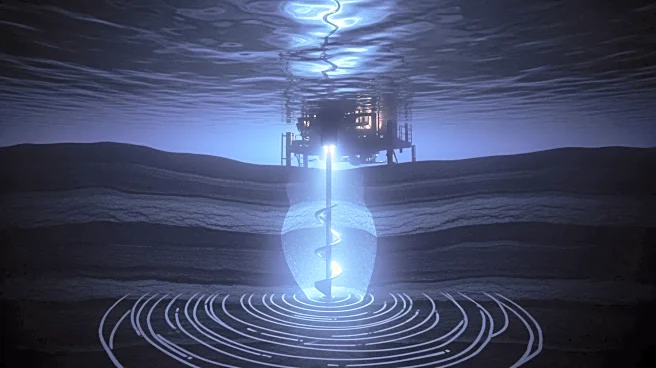
an ambitious ocean drilling project led by Christine Regalla and her team, which drilled 26,000 feet into the ocean floor. The study found that the main fault zone at the Japan Trench is composed of a thin, clay-rich band just below the seafloor. This weak and slick layer provided a surface for the 'megathrust' rupture to follow, resulting in significant shallow slip and displacement of the seafloor. This movement contributed to the generation of a catastrophic tsunami. The findings were published in the journal Science.
Why It's Important?
The discovery of the clay layer's role in the 2011 earthquake provides crucial insights into earthquake mechanisms, particularly in subduction zones. Understanding these dynamics is vital for predicting and preparing for future seismic events. The 2011 earthquake and tsunami were among the deadliest natural disasters in modern history, causing nearly 20,000 deaths and over $200 billion in damage. By identifying areas prone to similar shallow-slip earthquakes, scientists can help policymakers develop better building codes and emergency plans, potentially mitigating the impact of future disasters. This research underscores the global nature of such events, as tsunamis originating in Japan can affect distant regions like Hawaii.
What's Next?
The research team hopes their findings will aid in better forecasting large-magnitude earthquakes and tsunamis. By identifying locations most susceptible to such events, communities can enhance their resilience through improved infrastructure and evacuation strategies. The study highlights the need for ongoing research into subduction zones worldwide, as similar geological conditions may exist elsewhere, posing risks of significant seismic activity. Policymakers and scientists must collaborate to apply these insights to enhance global earthquake preparedness.
Beyond the Headlines
The study's implications extend beyond immediate disaster preparedness. It challenges existing assumptions about earthquake dynamics and highlights the importance of geological research in understanding natural disasters. The findings may influence future scientific exploration and funding priorities, emphasizing the need for advanced drilling technologies and international collaboration in seismology. Additionally, the research could inspire new approaches to studying other subduction zones, potentially leading to breakthroughs in earthquake science.