





What's Happening?
CDR David R. Stephan, USN, the commanding officer of the USS Franks (DD 554), died on April 4, 1945, from injuries sustained in a collision at sea two days prior. The incident occurred during a heavy storm on April 2, 1945, when the USS Franks, while
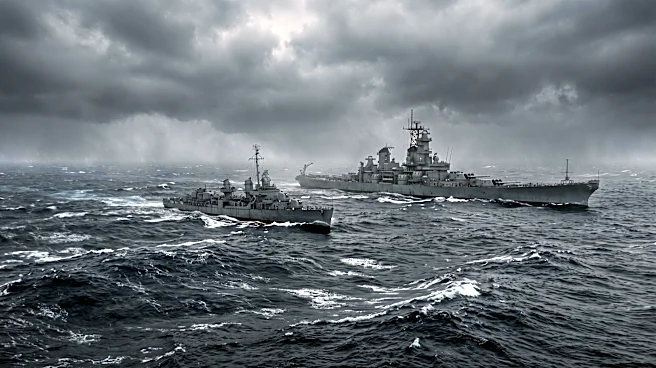
on duty as a Plane Guard Ship, was maneuvering to return to its assigned outer screen position from behind the aircraft carrier USS YORKTOWN. Steaming at 23 knots, the USS Franks side-swiped the 55,000-ton battleship USS NEW JERSEY. The initial impact demolished port side armament and the bridge wing, throwing CDR Stephan from the bridge to the deck below. He was buried at sea with full military honors. CDR Stephan had commanded the USS Franks since June 30, 1944, and was posthumously awarded the Bronze Star Medal for his heroic service, which included directing his ship in bombardments of Guam and Rota, operations on Palau Island, and covering the assault on Iwo Jima.
Why It's Important?
This event underscores the inherent dangers faced by naval personnel during wartime, even outside direct combat engagements. The collision, occurring during a heavy storm, highlights the challenging and often perilous conditions under which naval operations were conducted in World War II. The loss of a commanding officer like CDR Stephan, who had a distinguished record of service and leadership, represents a significant blow to naval command and morale. His posthumous Bronze Star Medal reflects the critical role he played in various Pacific theater operations, contributing materially to the success of the Third and Fifth Fleet. The incident also serves as a somber reminder of the non-combat casualties that occurred, emphasizing the constant risks associated with naval maneuvers and the unforgiving nature of the sea.
What's Next?
While this event occurred in 1945, its historical significance continues to be recognized through memorials and records. The Virtual Memorial Hall, for instance, preserves the memory of CDR Stephan and other naval officers, ensuring their sacrifices are not forgotten. Such records contribute to the historical understanding of naval operations and the human cost of war. For future naval operations, this incident, among others, likely contributed to the development of enhanced safety protocols, navigation procedures, and ship design improvements to mitigate risks associated with adverse weather conditions and close-quarters maneuvering. The ongoing study of historical naval incidents helps inform modern maritime safety and training.
Beyond the Headlines
The story of CDR Stephan extends beyond a mere casualty report, offering a glimpse into the personal lives and profound dedication of those serving in the military. His wife, Hazel, described him as a man of intense loves, deeply religious, and committed to a high code of moral and spiritual discipline. This personal dimension reveals the broader impact of such losses on families and communities, highlighting the sacrifices made by military families. The detailed account of his career, from his early assignments to his command of the USS Franks, illustrates the rigorous path of naval leadership. The preservation of such narratives in memorial halls and historical accounts ensures that the human element of military service, including the character and contributions of individuals like CDR Stephan, remains a vital part of national memory.